

Why are so many people from San Antonio, Houston, and Austin relocating to Dallas, and what does this migration wave mean for the DFW housing market?
Dallas is the number one destination for Texans on the move, attracting over 519,000 new residents last year alone, and this cross-generational migration is reshaping neighborhoods, pricing, and opportunity across the entire DFW Metroplex.
Why This Migration Wave Matters for Dallas Right Now
Here is the number that should get your attention: nearly one-third of all moves within Texas last year ended in the Dallas-Fort Worth-Arlington metro. According to the latest HireAHelper Texas Migration Report, 31.7% of all intra-state moves landed here. Not Houston. Not Austin. Dallas.
We have been watching this trend accelerate from our vantage point in East Dallas, and what makes 2026 different is the *type* of growth. This is not just young professionals chasing tech jobs. The U-Haul 2025 Midyear Growth Index ranked DFW as the number one metro for total net arrivals, and the data shows every generation is participating. Millennials, Gen X families, Gen Z renters, and Boomers looking to downsize are all landing here at the same time.
Having closed over 148 transactions across the Dallas-Fort Worth Metroplex, we can tell you firsthand that this cross-generational demand is creating a Dallas real estate market unlike anything we have seen before. And if you are sitting in San Antonio, Houston, or Austin right now weighing a move, the timing is actually in your favor.
Who Is Moving to Dallas from San Antonio and Other Texas Metros
Let’s break down where these new DFW residents are actually coming from. The data tells a clear story:
- Houston-Pasadena-The Woodlands: 19.4% of DFW’s new intra-Texas arrivals
- Austin-Round Rock-San Marcos: 13.4%
- San Antonio-New Braunfels: 8.4%
- Sherman-Denison: 4.2%
- Granbury: 3.8%
If you are in San Antonio right now, you are part of a well-established migration corridor. The U-Haul migration data specifically shows Dallas ranked as the top metro destination among movers from the San Antonio-New Braunfels area.
So why are San Antonio residents choosing Dallas? From what we see working with relocation clients every week, three factors keep coming up: career advancement, housing variety, and the sheer scale of what DFW offers. A CBRE analysis found that Dallas-Fort Worth was the number one metro for corporate headquarters relocations from 2018 through 2024, adding roughly 100 headquarters. That kind of job engine is hard to ignore when you are evaluating your next chapter.
One couple we recently worked with relocated from San Antonio’s Stone Oak area. They both worked in financial services and had hit a ceiling in their local job market. Within 60 days of landing in Dallas, one had received a promotion and the other had switched to a Fortune 500 company headquartered here. The career upgrade alone justified the move, and they were surprised to find that their dollar stretched further in several Dallas neighborhoods than they expected.
What Cross-Generational Migration Means for Dallas Neighborhoods
This is the insight that most market reports miss entirely. Dallas is not attracting just one demographic. Different generations are arriving with different priorities, and that is creating distinct demand patterns across DFW neighborhoods.
Millennials: Walkability and Urban Character
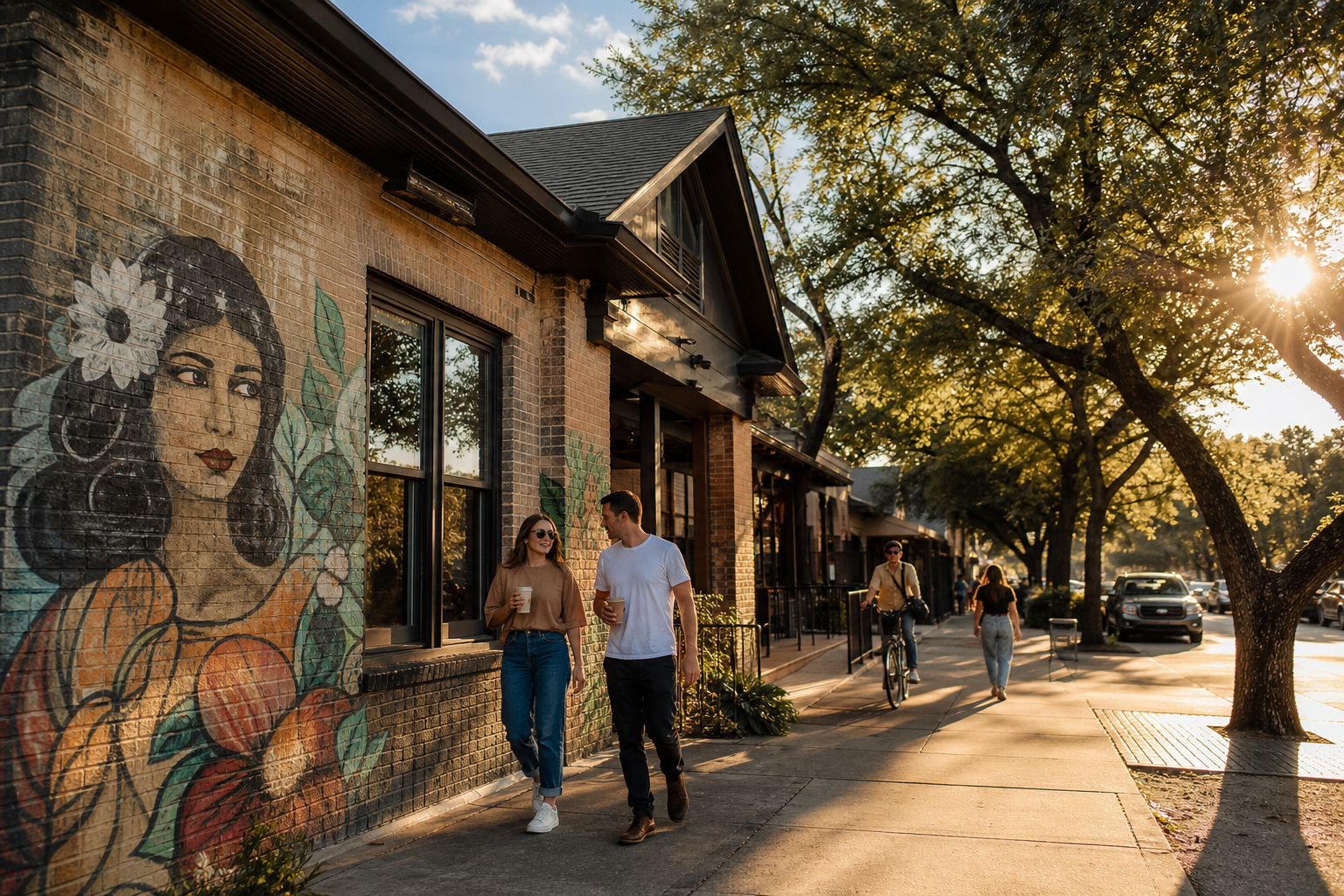
Millennials are gravitating toward neighborhoods like the Bishop Arts District in Oak Cliff, where the median sale price sits at $449,950 (down 10% from the prior year, creating a genuine buying window). Walk down Bishop Avenue on a Saturday morning and you will find coffee shops, hand-painted murals, and neighbors greeting each other by name. Spots like Emporium Pies, Hattie’s, and Oddfellows are not just restaurants. They are community gathering points. With a 12 to 18 minute commute to Downtown Dallas via I-35E or the DART Green Line, this neighborhood checks every box for young professionals who refuse to sacrifice culture for convenience.
Gen X Families: Schools, Space, and Stability
Gen X families are planting roots in established suburban school districts. Communities like Frisco and neighborhoods in Collin County continue to draw families who prioritize top-rated schools, larger homes, and convenient access to major employment corridors. The Texas Demographic Center projects Collin County alone will surpass 1.4 million residents by 2030.
Gen Z and Boomers: Opposite Ends, Same City
Gen Z renters are exploring walkable urban corridors where one-bedroom apartments average around $1,616 per month. Meanwhile, Boomers are downsizing into convenience-first communities closer to healthcare and services. When a market attracts people across all these generations simultaneously, it creates a more diverse and resilient pool of potential buyers and renters. For sellers, your potential buyer is not limited to one demographic. For buyers, it means DFW offers housing options ranging from historic Craftsman bungalows to master-planned suburban homes.
How Dallas Real Estate Compares to San Antonio’s Market Right Now
If you are evaluating a move from San Antonio, here is the honest comparison. The DFW median home sale price sat at $409,000 in June 2026, with prices decreasing 0.3% compared to the same month in 2025. Yes, that is higher than San Antonio’s median. But here is what that headline number does not tell you.
Dallas-Fort Worth’s inventory has surged nearly 40% compared to a year ago, with nearly 30,000 homes available at any given time. The average home now spends approximately 62 days on market before going under contract, and 47.3% of Dallas sellers reduced their list price in early 2026. This is a market that has shifted meaningfully in favor of buyers.
What does that actually mean for your wallet? It means you have negotiating power that did not exist two years ago. We recently helped a family relocating from Austin who initially assumed they would need to offer over asking price because that was their experience back home. Instead, they secured a home in East Dallas at $22,000 below list with a seller-funded rate buydown. The market has changed, and if you are still carrying assumptions from the 2021-2022 frenzy, you are leaving money on the table.
Meanwhile, San Antonio is dealing with its own softening driven by insurance cost increases and oversupply pressures. If you are going to navigate a shifting market anyway, the question becomes: where do you want to build equity long-term?
Where the Growth Is Headed in the Dallas-Fort Worth Metroplex
According to the latest census data, DFW’s population has grown from 2.4 million in 1970 to more than 8.5 million today, with projections suggesting it could exceed 12 million by 2050. Over the past year alone, the Metroplex added 123,557 residents, roughly 339 people per day. Fort Worth crossed the one million population mark, becoming the 11th largest city in the country.
But the growth is not evenly distributed. The real action is happening in specific corridors:
- Forney (Kaufman County): 10.4% growth with home prices still under $325,000
- Northlake (Denton County): Growing at roughly 13% annually with a median household income near $120,000
- Little Elm (Denton County): Absorbing spillover from Frisco
- Rockwall County: Following Forney’s upward trajectory
Closer-in Dallas neighborhoods like Lake Highlands and Lakewood remain resilient due to strong schools and proximity to amenities like White Rock Lake. Pricing is stable in these established areas, even as outer suburbs experience some correction from pandemic-era overbuilding.
With 6 years of experience and recognition as a best real estate agent Dallas since 2020 and a MetroTex 40 Under 40 honoree, we tell our clients the same thing: zip code matters more than the metro headline. The right neighborhood looks very different depending on your stage of life, budget, commute, and long-term goals.
What the Migration Data Means If You Are Buying or Selling in Dallas
The migration data reinforces something we have seen throughout the North Texas market: people are not moving here for just one reason. Employment opportunities, population growth, housing choices, amenities, and overall lifestyle all play a role.
For buyers relocating to DFW, only about 39% of new arrivals purchase a home within their first year. With mortgage rates holding in the low 6% range, many choose to rent first while exploring neighborhoods. That is a perfectly valid strategy, and with more than half of all new Texas arrivals holding a bachelor’s degree or higher and an average age of just 32, the rental-to-purchase pipeline remains strong.
For current Dallas homeowners, this sustained multi-generational demand means your buyer pool is broader than ever. Your home does not need to appeal to just one type of buyer. Sales volume in DFW increased 7.47% year-over-year in April 2026, confirming that despite price adjustments, transactions are still happening at a strong clip.
Frequently Asked Questions
Why is Dallas the top destination for Texans who are relocating?
Dallas leads because it combines the state’s strongest job market, the highest concentration of Fortune 500 headquarters in Texas, and a housing market offering genuine variety at every price point. With 23 Fortune 500 companies and roughly 100 corporate headquarters added from 2018 to 2024, the employment engine alone drives significant intra-state migration from metros like San Antonio, Houston, and Austin.
How many people are moving to Dallas from San Antonio each year?
According to the latest migration data, 8.4% of all intra-Texas moves to DFW originate from the San Antonio-New Braunfels metro area. When you combine that with arrivals from Houston (19.4%) and Austin (13.4%), nearly half of DFW’s domestic growth comes from within Texas. DFW posted a net gain of approximately 8,225 residents from domestic migration alone.
Is the Dallas housing market affordable compared to San Antonio?
The DFW median home sale price is $409,000 in mid-2026, which is higher than San Antonio’s median. However, inventory has surged nearly 40%, and 47.3% of sellers reduced their list price in early 2026. Fast-growing suburbs like Forney offer prices under $325,000, providing entry points comparable to or below many San Antonio neighborhoods.
What neighborhoods in Dallas are best for families relocating from other Texas cities?
Families prioritizing top schools gravitate toward Frisco, Allen, and Flower Mound in Collin and Denton Counties. Those seeking established urban neighborhoods with character often land in Lake Highlands or Lakewood. Your best fit depends on commute needs, school priorities, and lifestyle preferences, which is exactly where local expertise matters most.
How long are homes sitting on the market in Dallas right now?
The average home in Dallas-Fort Worth now spends approximately 62 days on market before going under contract. This is a significant increase from the pandemic-era norm and gives buyers substantially more leverage in negotiations, including the ability to request seller concessions like rate buydowns and closing cost contributions.
Is Dallas growing faster than Austin and Houston?
Yes. DFW leads Texas with a net gain of 8,225 residents from domestic migration, compared to Austin’s 5,860 and Houston’s 2,479. The Metroplex added 123,557 total residents over the past year, and projections suggest DFW could surpass Chicago in total population later this decade.
What is driving corporate relocations to Dallas-Fort Worth?
Texas has no state income tax, and DFW offers a central geographic location, a massive talent pool, relatively low business operating costs, and infrastructure to support rapid scaling. These factors have made DFW the number one metro for corporate headquarters relocations over the past six years, according to CBRE data.
Should I rent first before buying a home in Dallas?
Many relocating buyers do. Only about 39% of new arrivals purchase a home within their first year. With mortgage rates in the low 6% range, renting first lets you explore neighborhoods firsthand. One-bedroom apartments in popular areas like Bishop Arts average around $1,616 per month, giving you time to identify the right community without rushing.
What generation is driving the most moves to Dallas?
No single generation dominates. Millennials account for 32% of net domestic migration gains, Gen X represents 24%, and Gen Z makes up 14%. This cross-generational appeal is significant because it creates diverse housing demand, from urban condos to suburban family homes, making the market more resilient overall.
What are the fastest-growing suburbs in Dallas-Fort Worth right now?
Forney in Kaufman County posted 10.4% growth with prices under $325,000. Northlake in Denton County is growing at roughly 13% annually. Little Elm continues absorbing Frisco spillover, and Royse City in Rockwall County is following a similar upward trajectory. Collin County is projected to surpass 1.4 million residents by 2030.
The Bottom Line
The migration data is unambiguous: Dallas is where Texans are choosing to build their futures, and it is happening across every generation simultaneously. For buyers relocating from San Antonio and other Texas metros, the current market offers something rare: a combination of strong long-term growth fundamentals and the most buyer-friendly conditions DFW has seen since 2019.
The most important question is not whether Dallas is growing. It is which DFW community fits the way you want to live.
That is where we come in. With 84 five-star reviews, 148 closed transactions, and deep roots in East Dallas neighborhoods, the Unlocking DFW Realty team specializes in helping relocation buyers find the right fit. For more information about the homebuying process when relocating, the Consumer Finance Bureau’s homeownership guide provides valuable resources. Thinking about making the move to DFW? Reach out to us at 214-509-8094 and tell us what you are looking for. We will help you narrow down the communities that match your lifestyle, budget, and long-term goals.

Leave a Reply