


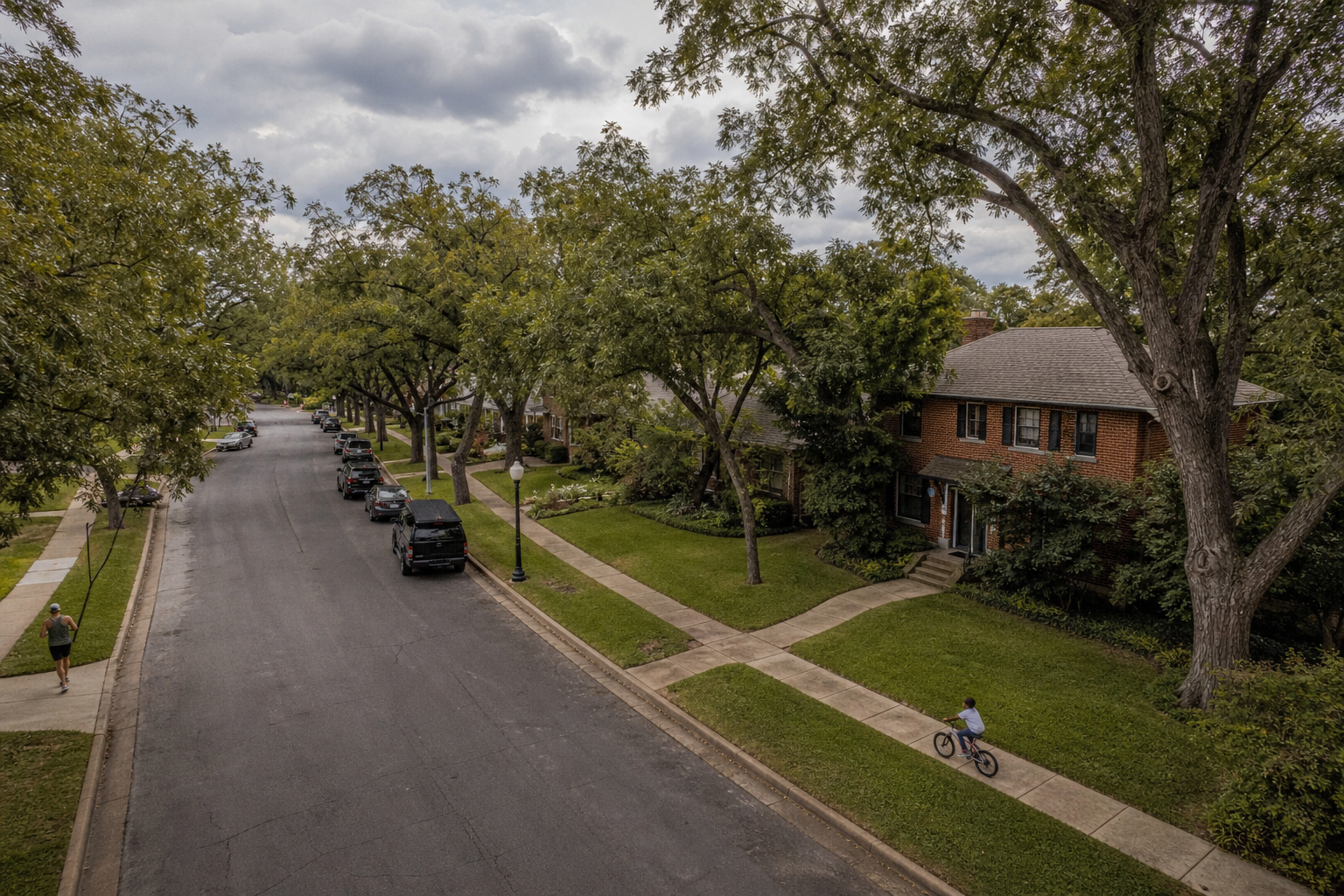
What should you look for beyond the house itself when evaluating traffic and road conditions before buying a home in Dallas?
Before you sign a contract on any Dallas home, visit the property at multiple times of day, observe traffic speed and volume on nearby roads, check for sidewalks and street lighting, and evaluate how the home sits relative to busy intersections or high-speed corridors.
Why This Matters Right Now in Dallas
We talk to buyers every week who have toured a home’s kitchen, counted closets, and measured bedrooms, but never once stepped outside to study the street in front of them. And we get it. When you are excited about a property, the last thing on your mind is the speed of traffic on the nearest boulevard.
But here is the reality: a home’s relationship to the road it sits on can shape your daily life, your family’s safety, and even the long-term condition of the property itself. On November 19, 2026, an SUV traveling eastbound on Kiest Boulevard in the East Oak Cliff area of Dallas left the roadway, struck a parked vehicle, and crashed into a residence on the 3200 block of Maryland Avenue. Residents had already expressed concerns about speeding along that corridor.
That incident is a stark reminder. While an event like this is unusual, the broader lesson is practical and applies to every Dallas neighborhood: the environment surrounding a home deserves as much scrutiny as what is inside it. With statewide inventory at approximately 5 months as of Q1 2026 and average days on market at 80 days statewide, per the Texas Real Estate Research Center, you have more time than in years past to do this homework. So let us walk through exactly how.
How to Evaluate Dallas Traffic Patterns Before Making an Offer
One thing we always tell our buyers: visit a property at least three different times before you write an offer, and make at least one of those visits during rush hour. Here is a simple framework you can use.
Visit at Multiple Times of Day
Traffic at 10 a.m. on a Tuesday tells you almost nothing about what that street feels like at 7:30 a.m. on a school morning or at 11 p.m. on a Friday. We recommend scheduling visits during:
- Early morning (7:00 to 8:30 a.m.) when school and work traffic peaks
- Evening rush (5:00 to 6:30 p.m.) when commuters are returning home
- Late night (after 10:00 p.m.) to gauge how the street feels in the dark and whether speeding is an issue
Observe Speed and Volume
Stand outside the home for 15 to 20 minutes and just watch. Are drivers moving faster than the posted limit? Do you see heavy truck traffic? Are vehicles cutting through the neighborhood to avoid a congested main road? These patterns will not show up in a listing description, but they will shape every morning you spend in that home.
Check Proximity to Arterials and Intersections
Properties located on a curve, at an unprotected intersection, or directly adjacent to a high-speed arterial road carry a different risk profile than those tucked into the interior of a residential block. The East Oak Cliff incident near Kiest Boulevard is one example. Residents had described concerns about traffic and speeding along that corridor. When you are evaluating Dallas neighborhoods, look at how the home sits relative to major roads and whether barriers, curbs, or setbacks exist between the home and the street.
What Dallas Families Should Look for in Sidewalks, Lighting, and Pedestrian Infrastructure
If you have kids, or if you plan to walk, jog, or bike in your neighborhood, the pedestrian infrastructure around a property matters just as much as the driveway.
Sidewalk Continuity
Walk the block. Are sidewalks present and continuous on both sides of the street? Do they connect to nearby parks, schools, or shopping areas? In some neighborhoods, sidewalks may be intermittent or absent altogether — something worth checking before you commit to a property. That gap can mean your child is walking in the street to get to a friend’s house.
Street Lighting
Drive by the property after dark. Are streetlights present and functioning? Are there dark stretches between lights? Adequate street lighting affects both pedestrian safety and your general sense of comfort in the neighborhood.
Crosswalks and Intersection Design
Check the nearest intersections. Are there marked crosswalks? Are there stop signs or signals, or is it a wide-open, uncontrolled intersection? For families with children, these details affect daily routines in ways you might not anticipate until you are living there.
What we consistently see with Dallas buyers is that families who do this walkthrough before submitting an offer feel significantly more confident about their decision. It takes 30 minutes, and it can save you from a situation where you are unhappy with something you cannot change.
Understanding Dallas Property Positioning and Road Risk
Not every home on a busy street carries the same level of exposure. Here is what to pay attention to.
Setback Distance
How far is the front of the home from the edge of the road? A deeper setback provides more buffer. Some homes in older neighborhoods were built close to the street, and setback distances can vary significantly from block to block.
Physical Barriers
Look for features that sit between the home and the road. These might include:
- Curbing along the roadway
- Mature trees or landscaping that could slow or redirect a vehicle
- Parked vehicles on the street (which can function as an informal barrier)
- Bollards or guardrails at corners or curves
Position Relative to Curves and Hills
A home located on the outside of a curve or at the bottom of a hill is in a different position than one on a straight, flat stretch. Physics does not care about property values, and vehicles that lose control tend to travel in a straight line off the curve. This is a simple observation, but it is one most buyers never think about.
The East Oak Cliff crash near Maryland Avenue and Kiest Boulevard illustrates this point. When an SUV left the roadway, it traveled in a straight line into a parked vehicle and then into the home. If you are looking at a property near a curve or a high-speed corridor in any Dallas neighborhood, ask yourself: what is between this home and a vehicle that might leave the road?
What Texas Seller Disclosure Law Means for Dallas Buyers
If a home has experienced previous structural damage, whether from a vehicle impact, storm, foundation movement, or any other cause, Texas law has specific requirements designed to protect you.
TREC Form 55-1 and Section 5.008
Under Section 5.008 of the Texas Property Code, sellers of previously occupied single-family residences are generally required to provide a Seller’s Disclosure Notice. The current version is TREC Form 55-1, effective as of May 28, 2026. This form requires disclosure of material facts and the physical condition of the property.
What does that mean practically? If the seller knows about prior significant structural damage, that information should appear on the disclosure form. If it does not, it may constitute a violation of the Texas Occupations Code to misrepresent or fail to disclose a known significant defect.
Your Right to Review and Terminate
Under the TREC One to Four Family Residential Contract, if a seller delivers the Seller’s Disclosure Notice, you have 7 days to review it and may terminate the contract for any reason within that window, with your earnest money refunded. If you never receive the notice, you may generally terminate at any time prior to closing.
This is something we point out to every buyer we work with: that 7-day window is not just a formality. Use it. Read every line of the disclosure notice. If the property sits near a busy road or has visible signs of prior exterior damage, the disclosure can tell you whether that damage has been professionally assessed and repaired.
Why Professional Inspection Matters
When a vehicle enters a structure, the damage often extends well beyond the visible surface. Exterior walls, roof framing, foundation connections, electrical systems, and plumbing can all be affected. TREC contracts explicitly permit buyers to have the property inspected by inspectors licensed by TREC or otherwise permitted by law.
If you are buying a property that has experienced any form of significant structural event, a standard home inspection may not be enough. Consider requesting a professional structural inspection by a licensed engineer.
Homeowners Insurance and Vehicle Impact: Questions to Ask in Dallas
Does homeowners insurance cover a vehicle crashing into your house? The honest answer is: it depends on your specific policy terms, exclusions, and deductibles. We are not insurance professionals, and we would never make a coverage promise.
What we tell our clients is this: before you close on any Dallas home, have a detailed conversation with your insurance provider about what your policy covers and what it does not. Specifically, ask about:
- Coverage for sudden structural damage from external events
- Your deductible and how it applies to different types of claims
- Exclusions that may limit or deny coverage in certain scenarios
- Additional living expenses if the home becomes uninhabitable during repairs
The Texas Department of Insurance is the appropriate authority source for specific insurance rules and guidance in Texas. If you want clarity on your rights, start there.
The 2026 market gives Dallas buyers more leverage than you might expect. According to the 2026 Texas Homebuyers and Sellers Report, 74% of Texas sellers reduced their asking price two or more times before selling.
Frequently Asked Questions
What should I check outside a home before buying in Dallas?
Walk the block and observe traffic speed, volume, sidewalk condition, street lighting, and the home’s distance from the nearest intersection or arterial road. Visit at multiple times of day, including early morning, evening rush, and after dark. These factors affect your daily experience and are easy to overlook when you are focused on interior features.
How can I evaluate traffic conditions in a Dallas neighborhood?
Spend at least 15 to 20 minutes outside the property during peak hours. Watch how fast cars travel, whether drivers cut through the neighborhood to avoid congestion, and how close the home sits to any curves or uncontrolled intersections. There is no substitute for being there in person at different times.
Does homeowners insurance cover a car crashing into a house in Texas?
Coverage depends on your specific policy terms, deductibles, and exclusions. We always recommend speaking directly with your insurance provider before closing. The Texas Department of Insurance is the appropriate authority for state-specific guidance on homeowners insurance questions.
What is the TREC Seller’s Disclosure Notice?
TREC Form 55-1, governed by Section 5.008 of the Texas Property Code and effective as of May 28, 2026, generally requires sellers of previously occupied single-family residences to disclose material facts and the physical condition of the property. This includes known structural damage, foundation issues, and other significant defects.
How long do I have to review a seller’s disclosure in Texas?
Under the TREC One to Four Family Residential Contract, if the seller delivers the Seller’s Disclosure Notice, you have 7 days to review it and may terminate the contract for any reason during that period, with your earnest money refunded. If you do not receive the notice, you may generally terminate at any time prior to closing.
Why should I request a structural inspection for a home near a busy road?
Structural damage from a vehicle impact or other external event can affect walls, roof framing, foundation connections, electrical systems, and plumbing in ways that are not visible during a standard walkthrough. TREC contracts allow buyers to have the property inspected by licensed professionals, and a structural engineer can identify issues a general inspector might miss.
What happened in the East Oak Cliff crash on November 19, 2026?
An SUV traveling eastbound on Kiest Boulevard in the East Oak Cliff area of Dallas left the roadway, struck a parked vehicle, and crashed into a residence on the 3200 block of Maryland Avenue.
Should families with children pay extra attention to road conditions when buying?
Absolutely. Sidewalk continuity, crosswalks, street lighting, and traffic speed all affect how safely your children can walk, bike, or play in the neighborhood. We recommend walking the full block and the route to the nearest school or park before making a decision.
How does the 2026 Dallas market affect my ability to do due diligence?
With statewide inventory at approximately 5 months as of Q1 2026 and average days on market at 80 days statewide, per the Texas Real Estate Research Center, buyers have more time to conduct inspections, review disclosures, and evaluate a property’s surroundings than they did in the tighter markets of recent years.
Can a home’s position on a street affect its long-term condition?
Yes. A home with minimal setback from a high-speed road, located on the outside of a curve, or near an unprotected intersection may face different long-term considerations than one tucked into the interior of a residential block. Evaluating these factors before you buy is one of the most practical steps you can take.
The Bottom Line
A home is more than its walls, its finishes, and its square footage. The street it faces, the speed of traffic, the sidewalks your kids will walk on, and the distance between the front door and the nearest high-speed corridor all matter. The East Oak Cliff incident near Kiest Boulevard and Maryland Avenue reminds us that these are not abstract considerations.
We encourage every Dallas buyer to step outside the front door of any home they are considering and study the environment around it. Visit at different hours. Walk the block. Check the lighting after dark. Read every line of the Seller’s Disclosure Notice and exercise your right to have the property professionally inspected.
Contact Jamie Simpson, Unlocking DFW Realty: call 2145098094, email jamie@unlocking-dfw.com, or visit unlocking-dfw.com.

Leave a Reply