

How could the Dallas Design District’s redevelopment influence your decision about where to buy a home?
The Dallas Design District’s transformation from a largely commercial and industrial corridor into a mixed-use destination with dining, shopping and residential options is changing the way buyers evaluate this part of the city, making neighborhood amenities and walkability as important as the home itself.
Why the Dallas Design District Matters to Home Buyers Right Now
If you’ve been watching the Dallas Design District over the past couple of years, you’ve noticed a shift that goes well beyond a fresh coat of paint on old warehouses. The area is moving from an enclave of furniture showrooms, galleries and industrial spaces into something much more layered, and that evolution is reaching a tipping point in late 2026.
The most visible proof is The Seam, a roughly 160,000-square-foot adaptive-reuse redevelopment at 1444 Oak Lawn Avenue, where developer Asana Partners has completed shell construction on the former Oak Lawn Design Plaza. According to a CandysDirt.com report published October 8, 2026, individual tenants are now building out their spaces, and several aim to open by the end of this year. At the same time, the historic Cabana Hotel is being redeveloped into a 175-unit mixed-income residential community, and the Urby development has brought hundreds of upscale apartments to Hi Line Drive.
What does this mean if you’re shopping for a home in Dallas?
What The Seam at 1444 Oak Lawn Avenue Adds to the Dallas Design District
You might be wondering: why should a commercial redevelopment matter to someone buying a home? The answer is surprisingly practical. The Seam is not a housing project. It is a dining, retail, wellness and showroom destination that will eventually hold approximately 50 individual tenant spaces. But it reshapes the daily-life experience of living nearby, and that is exactly what many buyers are weighing when they compare neighborhoods.
Here is what we know about The Seam based on reporting from CandysDirt.com as of October 8, 2026:
- Aba, a Mediterranean restaurant, is building out its space
- Maman, a French-inspired café and bakery, is also in the build-out phase
- Harbour, an Australian luxury outdoor furniture brand, is preparing a 6,700-square-foot showroom
- Lumis Cocktail Lounge, a design-focused cocktail bar, is among the confirmed tenants
What I tell my clients is that there is an important distinction between amenities you can enjoy today and amenities that are in development. Shell construction is complete, but no official opening date has been announced for The Seam as a whole. If a walkable café or a Mediterranean dinner spot within strolling distance matters to you, confirm which tenants have actually opened their doors before you base your purchase decision on that convenience.
The project’s approach is also worth understanding. Rather than demolishing the 1970s-era Oak Lawn Design Plaza, Asana Partners retained the existing structures. Morris Adjmi Architects handled the design, GFF Design served as architect of record, and Adolfson & Peterson Construction completed the shell work. Updates include new facades, mechanical and electrical systems, structural steel, roofing, lighting, landscaping and sidewalks. This adaptive-reuse approach preserves some of the area’s architectural character while introducing entirely new uses.
How Dallas Design District Walkability Is Evolving Block by Block
One thing we consistently emphasize at Unlocking DFW is that walkability is about connections, not just destinations. Having a great restaurant a quarter mile away does not mean much if the path between your front door and that restaurant involves crossing an unlit parking lot or navigating a road with no sidewalk.
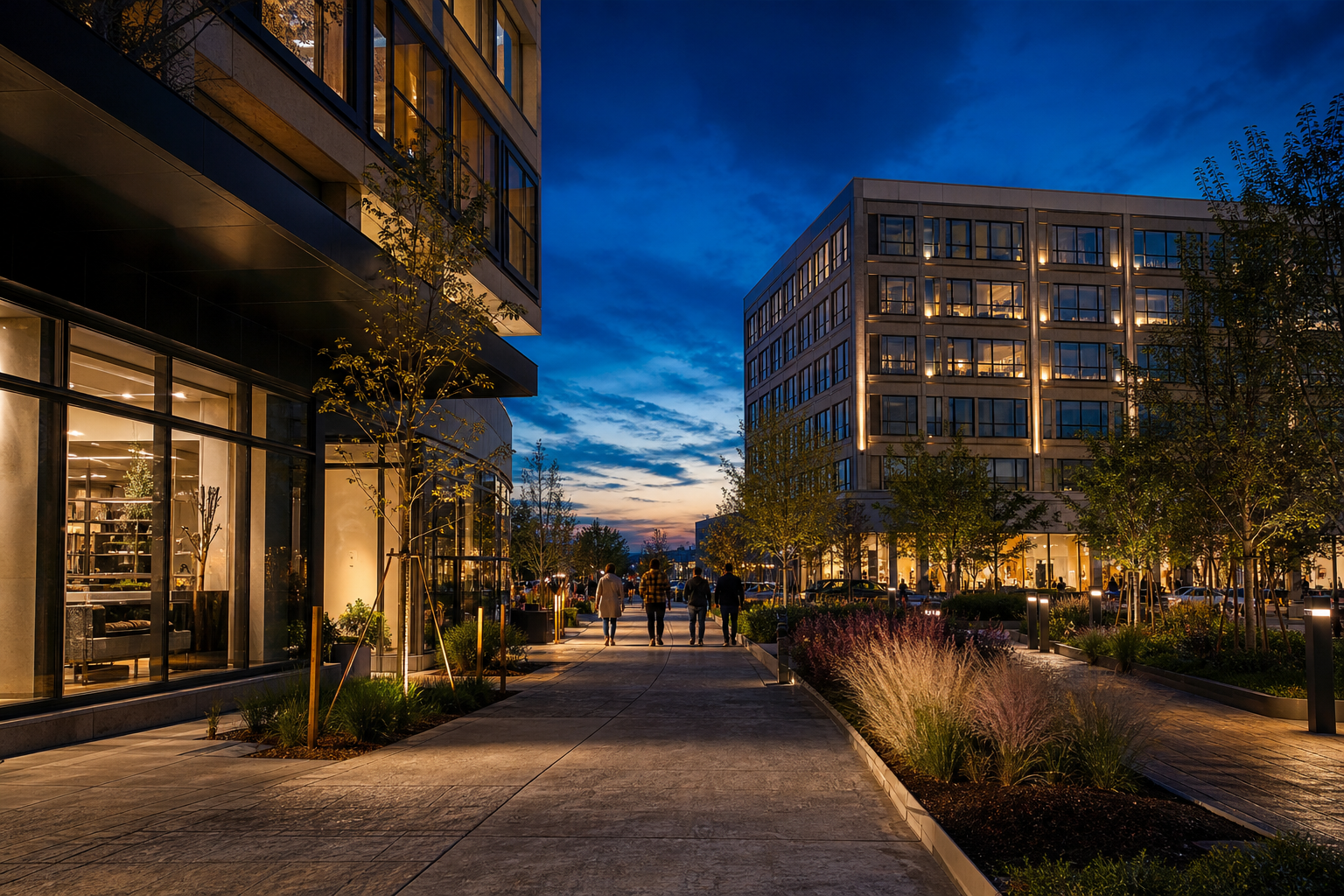
The Seam’s site improvements include new sidewalks, hardscaping and pedestrian-friendly landscaping, which is a meaningful upgrade for the immediate area around 1444 Oak Lawn Avenue. Beyond the project itself, planned improvements to The Loop are intended to strengthen pedestrian connectivity between the Design District, Victory Park, Katy Trail and West Dallas.
Here is what you should do if walkability matters to you:
- Walk the route yourself. Visit the Design District at different times of day. Test the path from the property you are considering to the places you would actually go.
- Look at crossing quality. Where do you need to cross major streets? Are there signals, crosswalks and adequate lighting?
- Check connectivity, not just proximity. A destination can be close on a map but difficult to reach on foot if the infrastructure between you and it is incomplete.
- Ask about The Loop’s current status. The improvements are planned, but the current construction and completion timeline was not independently verified in our research. Ask your agent to check the latest progress.
With 6 years of experience and 148 closed transactions across DFW, we have walked a lot of Dallas neighborhoods with clients. What I see consistently is that buyers who test walkability in person, rather than relying on online scores or marketing materials, make more confident choices.
The Broader Dallas Design District Transformation and What It Means for You
The Seam is the most talked-about piece of the puzzle, but it is not the only one. The Dallas Design District’s evolution involves several simultaneous changes that together are reshaping the area’s identity.
New Residential Options in the District
The historic Cabana Hotel is being redeveloped into a 175-unit mixed-income residential community, according to the CandysDirt.com report. Meanwhile, the Urby development on Hi Line Drive has introduced hundreds of upscale apartments. These projects are adding actual residents to a district that was historically a primarily commercial area. Both residential and retail and dining activity are underway in the district concurrently.
What This Means for Buyers Comparing Dallas Neighborhoods
If you are comparing the Design District with nearby urban areas like Uptown, Victory Park or Oak Lawn, pay attention to the differences in housing type, price range and daily-life experience. The Design District has traditionally been known as a commercial destination, and the recent residential additions are changing that profile. You should not assume that every Dallas urban neighborhood offers the same lifestyle, even when they are geographically close.
Trade-Offs You Need to Consider
Here is something we always want to be honest about: new commercial development brings both benefits and practical challenges. Construction activity means noise, dust and disruption during the build-out phase. Increased dining and retail traffic can mean parking pressure and busier streets. The character of a neighborhood in transition is, by definition, not settled yet.
The in-progress nature of The Seam is a perfect example. You might love the idea of having Aba and Maman within walking distance, but if those tenants have not opened when you move in, you are living near a construction site, not a lifestyle destination. Plan accordingly.
How the Dallas Market Context Shapes Your Design District Decision
You are not making a neighborhood decision in a vacuum. The broader Dallas and Texas housing market conditions affect your leverage, your timeline and your options.
According to the Texas REALTORS Q1 2026 Quarterly Housing Report, the statewide median home price in Texas was $328,000 as of Q1 2026, down 0.8% year-over-year, marking the first annual decline in more than a decade. Texas homes averaged 80 days on market in Q1 2026, six days longer than the same period the year before. Statewide inventory reached approximately 5 months of supply.
Here is the number that really jumps out: per the 2026 Texas Homebuyers and Sellers Report, 74% of Texas sellers reduced their asking price two or more times before completing a sale. That is a significant data point for buyers.
The Dallas metro specifically saw closed sales decline by less than 2% compared with Q1 2025, per the same Texas REALTORS report. Statewide active listings rose 7.4% year-over-year as of Q1 2026.
What does this actually mean for your search in the Dallas Design District? It means the statewide market has shifted in a buyer-favorable direction — though you should ask your agent to pull current NTREIS data for the specific ZIP codes you are considering before drawing conclusions about your negotiating position. It also means you should not rush a decision based on development hype alone. Ask your agent to pull current NTREIS data specific to the ZIP codes you are considering so you can compare real numbers, not assumptions.
As a D Magazine Best Real Estate Agent since 2020 and a Real Estate Negotiation Expert (RENE), I can tell you that the buyers who do best in markets like this are the ones who combine enthusiasm for a neighborhood with disciplined analysis of the numbers.
Redevelopment Near Your Home Is Not a Guarantee of Appreciation in the Dallas Design District
This is important enough to deserve its own section: you should not treat The Seam or any nearby development as evidence that home values will automatically increase. That is a common assumption, and it can lead to overpaying.
New commercial activity can expand amenities and attract further investment, but the relationship between a single development and residential property values is complex, indirect, and influenced by many variables including interest rates, inventory, job growth and broader economic conditions.
The fact that 74% of Texas sellers in 2026 reduced their asking price two or more times before selling, per the Texas Homebuyers and Sellers Report, is a useful reminder that market conditions, not nearby development alone, determine outcomes. Additionally, the 2026 Texas Homebuyers and Sellers Report found that 60% of Texas buyers rated commuting costs as very or somewhat important when choosing a home location, a reminder that practical geography is a significant factor in how Texas buyers choose a home location.
We encourage every buyer to separate what a neighborhood might become from what it is today, and to base your offer on current comparable sales data rather than future projections.
Frequently Asked Questions About Buying Near the Dallas Design District
What is The Seam in the Dallas Design District?
The Seam is a roughly 160,000-square-foot adaptive-reuse redevelopment at 1444 Oak Lawn Avenue. Developer Asana Partners is converting the former Oak Lawn Design Plaza, a 1970s office complex, into a destination with approximately 50 spaces for restaurants, boutiques, wellness businesses and showrooms. Shell construction is complete, and tenants are building out their spaces, according to CandysDirt.com reporting from October 8, 2026.
When will The Seam open in the Dallas Design District?
No official opening date has been announced. Several confirmed tenants, including Aba, Maman, Harbour and Lumis Cocktail Lounge, have indicated they aim to open by the end of 2026, per CandysDirt.com as of October 8, 2026. You should verify individual opening dates directly before making purchasing decisions based on these amenities.
Is the Dallas Design District a good place to buy a home?
That depends on your priorities. The Design District is evolving rapidly, with new residential options like the Cabana Hotel redevelopment and the Urby apartments on Hi Line Drive. If you value walkable dining, shopping and urban energy, the area may fit well. If you prefer a fully established neighborhood with predictable character, the ongoing transformation may present trade-offs worth considering.
What restaurants and shops are coming to The Seam in the Dallas Design District?
Confirmed tenants building out their spaces include Aba (Mediterranean restaurant), Maman (French-inspired café and bakery), Harbour (Australian luxury outdoor furniture with a 6,700-square-foot showroom) and Lumis Cocktail Lounge, per CandysDirt.com as of October 8, 2026. Additional tenants among the approximately 50 total spaces have not been publicly confirmed.
How walkable is the Dallas Design District?
Walkability in the Design District varies by block. The Seam’s site improvements include new sidewalks and landscaping. Planned improvements to The Loop aim to connect the Design District with Victory Park, Katy Trail and West Dallas. We recommend walking the actual routes from any property you are considering to test the experience firsthand.
What is adaptive reuse, and how does it apply to the Dallas Design District?
Adaptive reuse is the process of repurposing existing buildings for new functions rather than demolishing them. The Seam is a prominent example: the 1970s Oak Lawn Design Plaza was retained and upgraded with new facades, systems and infrastructure rather than torn down. This approach can preserve some neighborhood character while introducing new uses.
Does nearby commercial development automatically increase home values in Dallas?
Not automatically. While new amenities can make an area more attractive, property values are influenced by many factors including interest rates, inventory levels, job growth and broader market conditions. Per the 2026 Texas Homebuyers and Sellers Report, 74% of Texas sellers reduced their asking price two or more times before selling, underscoring that market dynamics, not individual projects, drive pricing outcomes.
What are the trade-offs of buying a home near an active redevelopment in the Dallas Design District?
Potential benefits include access to new dining, shopping and lifestyle amenities. Potential challenges include construction noise, increased traffic, parking pressure and the uncertainty of living in a neighborhood whose character is still being defined. You should visit the area at different times of day to get an honest sense of the current conditions.
What residential projects are underway in the Dallas Design District?
According to CandysDirt.com reporting from October 8, 2026, the historic Cabana Hotel is being redeveloped into a 175-unit mixed-income residential community, and the Urby development has introduced hundreds of upscale apartments on Hi Line Drive. These projects are adding residential population to what was historically a primarily commercial area.
How do I research neighborhood development before buying a home in the Dallas Design District?
Start by asking your real estate agent for current MLS data specific to the ZIP codes you are considering. Check the City of Dallas planning and development records for permitted projects. Visit the area in person. Walk the streets, test the pedestrian routes, talk to local business owners and look for active construction sites. Separate what is open today from what is planned or under construction.
The Bottom Line
The Dallas Design District is in the middle of a meaningful transformation, and The Seam at 1444 Oak Lawn Avenue is one of the most tangible examples of how that is unfolding. But the smartest approach to buying in or near this area is to balance your excitement about future amenities with clear-eyed analysis of current conditions, actual walkability and real market data.
With 84 five-star reviews and recognition including the MetroTex 40 Under 40 and Dallas Observer Readers’ Choice Best Real Estate Team, we at Unlocking DFW Realty have spent years helping buyers navigate exactly these kinds of neighborhood decisions across Dallas. Our office is approximately two miles east of the Design District, so this is a part of the city we know well.
If you are considering homes in or near the Dallas Design District and want current data, honest guidance on trade-offs, and a team that knows this market inside and out, reach out to us at Unlocking DFW Realty. You can call us at 214-509-8094 or visit our website to start the conversation. We would love to help you figure out whether the Design District’s next chapter aligns with yours.

Leave a Reply