
Is the Junius Heights historic district in East Dallas worth buying into in 2026, or does the preservation overlay make renovations too restrictive for today’s buyers?
Yes, Junius Heights is worth serious consideration in 2026. The preservation overlay generally governs exterior changes, meaning you can typically modernize kitchens, bathrooms, and mechanical systems — though buyers should confirm whether any interior-specific provisions apply with the Dallas Office of Historic Preservation. while the overlay protects the architectural character that drew you to East Dallas in the first place.
Why This Matters for East Dallas Buyers Right Now
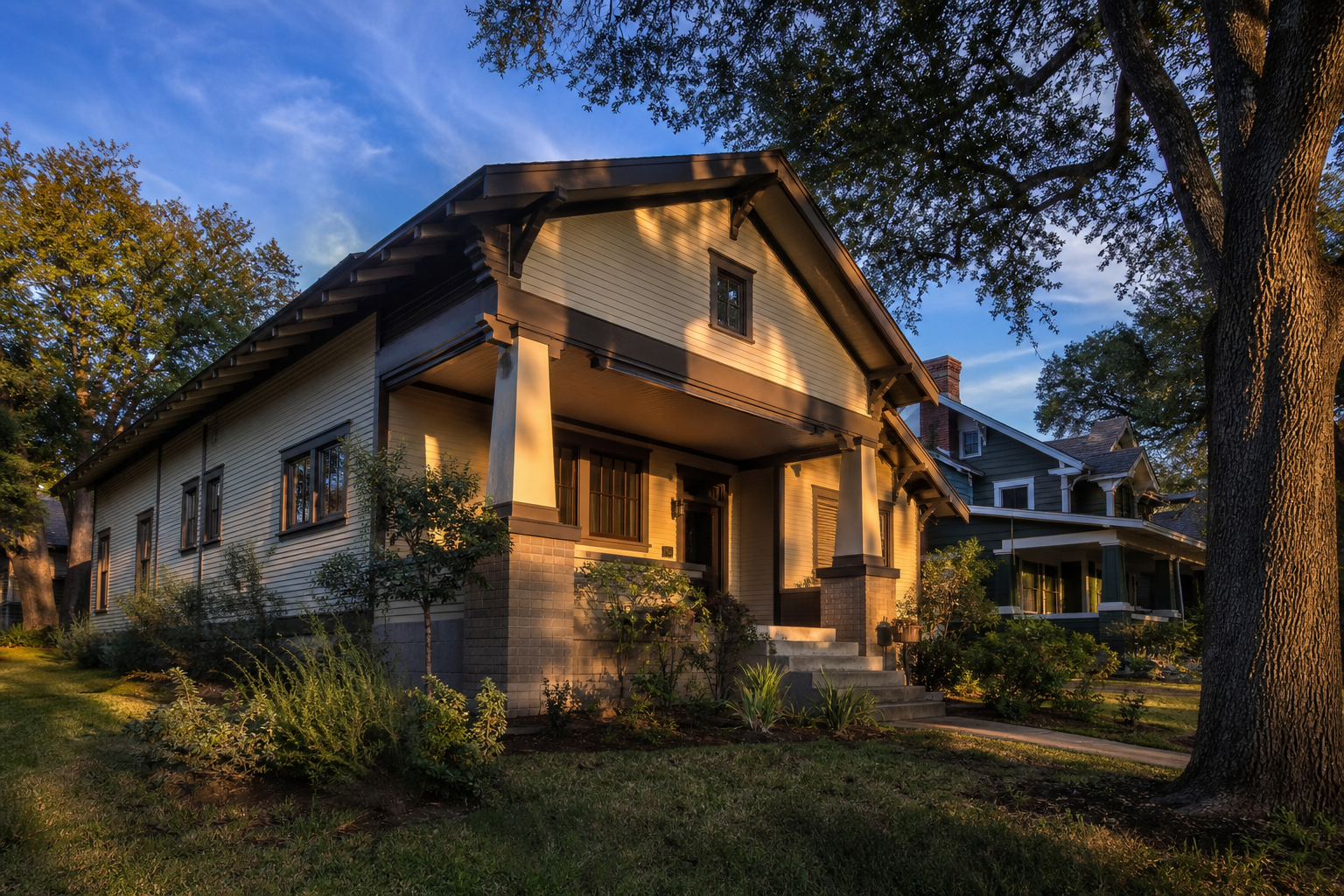
If you’re house hunting in East Dallas, Junius Heights is one of those neighborhoods that stops you mid-scroll. The Craftsman porches, the Prairie-style rooflines, the Tudor details you just don’t find in new construction. But then you read “historic overlay district,” and a question creeps in: will the city tell me what I can and can’t do with my own home?
We hear this concern constantly. As a team that has closed over 148 transactions and specializes in East Dallas neighborhoods, we can tell you this is one of the most common misconceptions we encounter. The reality is far more nuanced, and far more buyer-friendly, than most people assume.
The broader DFW market is giving you a window right now, too. The Dallas-Fort Worth-Arlington MSA carried 4.6 months of inventory as of Q1 2026, according to Texas home sales data, putting the metro at the upper edge of a balanced market. But in a constrained-supply neighborhood like Junius Heights, where the overlay limits teardowns and new construction, your competition for available homes may be tighter than that metro average suggests.
What the Junius Heights Preservation Overlay Actually Controls in East Dallas
Here’s the single most important thing we tell buyers considering Junius Heights: the preservation overlay applies to the exterior of structures. Interior renovations are generally not regulated.
That distinction changes everything. Let’s break down what the overlay specifically addresses on the outside, according to the Junius Heights ordinance (Ordinance No. 26331, dated April 26, 2006):
- Siding and trim: Historic wood siding, trim, and detailing must be restored wherever practical. All exposed wood must be painted, stained, or otherwise preserved.
- Windows and glass: Glass and glazing must match historic materials as much as practical. Films, dark tinted, or reflective glazings are not permitted.
- Facade proportions: Historic solid-to-void ratios of protected facades must be maintained, meaning you can’t turn a charming front elevation into a wall of plate glass.
- Color palette: Colors appropriate to the period of historic significance are recommended. No fluorescent or metallic colors are permitted on exteriors.
- New additions: Must be compatible with historic materials, features, size, scale, proportion, and massing, and must be differentiated from the original structure.
Before you alter any exterior element, place, construct, expand, demolish, or remove any structure, you generally need to obtain a Certificate of Appropriateness — exceptions may apply as provided in the preservation criteria, so confirm the scope of your project with the Dallas Office of Historic Preservation. The Dallas Landmark Commission reviews these applications using the Secretary of the Interior’s Standards for the Rehabilitation of Historic Properties.
So what does this actually mean for your daily life? You can gut a kitchen. You can add a luxury primary bath. You can rewire the entire house, replace plumbing, install new HVAC, refinish floors, and build custom cabinetry. The overlay generally governs what your neighbors and the street see, not what you live with inside — though buyers should confirm with the Dallas Office of Historic Preservation at (214) 670-4206 whether any interior-specific provisions apply to their project.
What You Can Modernize Inside a Junius Heights Home Without Any Overlay Approval
This is where buyers often feel a wave of relief. Let’s be specific about what falls outside the overlay’s reach:
- Kitchen remodels: Countertops, cabinetry, appliances, layout changes, everything inside the walls is yours to reimagine.
- Bathroom renovations: Tile, fixtures, vanities, walk-in showers, heated floors, all fair game.
- Mechanical systems: Electrical wiring, plumbing, HVAC, insulation, smart home technology, none of this requires a Certificate of Appropriateness.
- Flooring: Hardwood restoration, new flooring materials, subfloor work.
- Foundation repair: Structural work that preserves the building qualifies as rehabilitation.
The distinction is straightforward: if it’s behind the walls or under the roof and doesn’t change what the exterior looks like, you’re working within the same rules as any other Dallas homeowner. In our experience working with buyers across East Dallas, this interior freedom is what makes the overlay feel less like a restriction and more like a guardrail that keeps the neighborhood looking the way you wanted it to look when you fell in love with it.
The Tax Benefit Most East Dallas Buyers Don’t Know About in Junius Heights
Here’s a detail that can shift your entire value calculation. Junius Heights is explicitly named as a “Revitalizing Historic District” under Dallas’s historic preservation tax exemption ordinance (Article XI), according to City of Dallas documentation.
Qualifying rehabilitation, defined as labor and materials for interior or exterior repair or replacement of features that help preserve a historic property and become a permanent part of the building, may qualify for a tax exemption under a rehabilitation project. The ordinance specifically includes cabinetry, electrical wiring, carpentry, flooring, foundation, paint, plumbing, and roofing as qualifying categories.
What does that mean in plain terms? Some of the renovation work you’re already planning to do could potentially reduce your property tax burden. That’s a financial incentive that works in your favor precisely because of the historic overlay, not in spite of it.
We always recommend buyers contact the Dallas Office of Historic Preservation directly at (214) 670-4206 to confirm current exemption thresholds and eligibility requirements, since those details can change. Their office is at 1500 Marilla Street, Room 5CN, Dallas, TX 75201. But the possibility alone is worth a phone call before you finalize your numbers.
Why Neighborhood Due Diligence in East Dallas Goes Beyond the Listing Photos
When we’re looking at a home with a buyer in Junius Heights or anywhere in East Dallas, we encourage them to consider more than what’s inside the property lines. Look at the surrounding streets, nearby businesses, traffic patterns, parks, schools, and public transportation. These are the factors that shape everyday life long after the excitement of closing day fades.
Junius Heights gives you plenty to evaluate. The neighborhood contains over 800 residences featuring Craftsman, Prairie, and Tudor architectural styles, according to the City of Dallas historic preservation records. Lipscomb Elementary sits within the district boundary at 5801 Worth Street. The Junius Heights Columns, originally constructed in 1917, served as a gateway to the Junius Heights Second Addition, featuring 30-foot masonry pillars that were originally connected by an iron rainbow arch. The Old Lakewood Library, constructed in 1937 at 6342 La Vista Drive, is one of the oldest library branches in the city, and the Lakewood Theater with its iconic neon tower anchors the surrounding shopping district.
We also encourage buyers, especially relocation buyers who may not have years of familiarity with Dallas neighborhoods, to visit the area at different times of day. A neighborhood can feel completely different on a weekday morning versus after dark. Those observations give you context that a listing description simply cannot provide. One news story or incident should not define an entire neighborhood. The goal is to look at the bigger picture and make sure the neighborhood, location, and lifestyle fit what you’re looking for before you commit.
With 84 five-star reviews from past clients, we’ve built our reputation on exactly this kind of thorough, boots-on-the-ground guidance. A map tells you where a house is. Local knowledge helps you understand what surrounds it.
How the East Dallas Market Context Affects Your Junius Heights Decision in 2026
Let’s zoom out for a moment. The Texas statewide median home price declined 0.8% in Q1 2026 compared to Q1 2025, per the Texas REALTORS association. Homes statewide averaged 80 days on market in Q1 2026, six days longer than the same period last year. Statewide, active listings rose by 7.4% compared to Q1 of the prior year, according to the same Texas REALTORS report, though the pace of inventory growth is slowing compared to the prior three first quarters that each saw increases of more than 30%.
But here’s the key nuance: a historic overlay district like Junius Heights doesn’t behave like the broader metro. The overlay limits teardowns and restricts new construction to additions compatible with the existing historic fabric. That means the supply of available homes is inherently constrained. You can’t just knock down a Craftsman bungalow and build a modern box in its place.
For you as a buyer, this creates a different dynamic. Inventory in Junius Heights may be tighter than the 4.6 months the DFW real estate market carried in Q1 2026. When a well-maintained or thoughtfully renovated home hits the market in this district, it draws attention. As a Real Estate Negotiation Expert (RENE) and D Magazine Best Real Estate Agent since 2020, what we consistently see in these East Dallas historic pockets is that buyers who understand the overlay and do their homework ahead of time are the ones positioned to act confidently when the right home appears.
How the Certificate of Appropriateness Process Works in Junius Heights
If you do plan exterior work, the Certificate of Appropriateness process is more predictable than you might think. Here’s what to expect:
- Scope your project: Identify which exterior elements you want to alter, repair, or add.
- Review the preservation criteria: The criteria attached as Exhibit B to Ordinance No. 26331 spell out what’s expected. If there’s a conflict between the overlay standards and the underlying zoning, the overlay controls.
- Submit your application: The Dallas Landmark Commission reviews applications using the Secretary of the Interior’s Standards for the Rehabilitation of Historic Properties.
- Design compatible additions: New work must be differentiated from the old while remaining compatible with historic materials, features, size, scale, proportion, and massing. If removed in the future, the essential form and integrity of the historic property must remain unimpaired.
The process is designed to preserve the neighborhood’s character, not to prevent you from maintaining or improving your home. Restoring original wood details, repainting in period-appropriate colors, replacing windows with historically compatible options: these are the kinds of projects the system is built to support.
Before purchasing, we recommend confirming with the Dallas Office of Historic Preservation that no amendments have been adopted to the original ordinance since 2006.
Frequently Asked Questions About Buying in Junius Heights East Dallas
Can I remodel my kitchen and bathrooms in a Junius Heights home?
Yes. The Junius Heights preservation overlay governs the exterior of structures. Interior renovations, including kitchens, bathrooms, flooring, electrical, plumbing, and HVAC, are generally not regulated by the overlay, unless specific provisions apply — confirm with the Dallas Office of Historic Preservation at (214) 670-4206. In most cases, you have the same freedom to modernize the inside of your home as any other Dallas homeowner — confirm with the Dallas Office of Historic Preservation whether any interior-specific provisions apply to your property.
What is a Certificate of Appropriateness and when do I need one in Junius Heights?
A Certificate of Appropriateness is required before you alter the exterior of a structure, place or construct new elements, expand, demolish, or remove any structure within the Junius Heights historic district. The Dallas Landmark Commission reviews applications using the Secretary of the Interior’s Standards for the Rehabilitation of Historic Properties.
Does the Junius Heights overlay control paint colors on my home?
The overlay recommends colors appropriate to the period of historic significance and prohibits fluorescent or metallic colors on exteriors. Within that framework, you have flexibility to choose from a wide palette. All exposed wood must be painted, stained, or otherwise preserved per the ordinance.
Can I add an addition to a home in the Junius Heights historic district?
Yes, but additions must be compatible with historic materials, features, size, scale, proportion, and massing. New work must be differentiated from the original structure, and the addition must be designed so that if removed in the future, the essential form and integrity of the historic property would be unimpaired.
Are there tax benefits for renovating a home in Junius Heights East Dallas?
Junius Heights is named as a “Revitalizing Historic District” under Dallas’s Article XI historic preservation tax exemption ordinance. Qualifying rehabilitation work, which may include cabinetry, electrical, carpentry, flooring, foundation, paint, plumbing, and roofing, may qualify for a tax exemption. Contact the Dallas Office of Historic Preservation at (214) 670-4206 to confirm current eligibility and thresholds.
What architectural styles are found in Junius Heights?
Junius Heights contains over 800 residences in Craftsman, Prairie, and Tudor architectural styles, per the City of Dallas historic preservation records. The district was established in 1906 as a streetcar development, and many of its original design features remain intact.
Can I replace windows in a Junius Heights home?
Glass and glazing must match historic materials as much as practical. Films, dark tinted, or reflective glazings are not permitted. You can replace windows, but the replacements should be compatible with the historic character of the home.
How does inventory in Junius Heights compare to the broader DFW market?
However, because the overlay limits teardowns and new construction, Junius Heights may experience tighter inventory than the broader metro average, whether from the overlay’s limits on teardowns and new construction or other neighborhood-specific factors. No ZIP-level data was available for the neighborhood specifically.
What should relocation buyers know before buying in Junius Heights East Dallas?
Relocation buyers should visit the neighborhood at different times of day, research surrounding streets and businesses, and evaluate nearby parks, schools (such as Lipscomb Elementary at 5801 Worth St), and transit access. Local landmarks like the Lakewood Theater and the Old Lakewood Library at 6342 La Vista Drive anchor a walkable shopping district nearby.
Does the historic overlay affect my home’s resale value in Junius Heights?
The overlay protects the architectural character that makes Junius Heights desirable, limits incompatible development, and constrains supply. How these factors affect resale value in any individual case will depend on condition, location within the district, and market conditions at the time of sale — an agent familiar with the micro-market can help you evaluate comparable sales.
The Bottom Line on Buying in Junius Heights East Dallas
The Junius Heights preservation overlay is not the renovation roadblock most buyers fear. It protects the Craftsman porches, Tudor details, and Prairie rooflines that make this East Dallas neighborhood unlike anything else in the DFW market, while generally leaving your interior in your hands — confirm with the Dallas Office of Historic Preservation whether any interior-specific provisions apply. Add in the potential for property tax benefits through the Revitalizing Historic District designation, and the overlay starts to look less like a burden and more like a built-in value protector for home pricing strategy.
Your homework before buying: visit at different times of day, walk the surrounding streets, and contact the Dallas Office of Historic Preservation to understand both the approval process and the tax incentive program. With 6 years of experience, 148 closed transactions, and recognition as a D Magazine Best Real Estate Agent and MetroTex 40 Under 40 honoree, we at Unlocking DFW Realty help East Dallas buyers navigate exactly these decisions every day. If you’re considering Junius Heights or any East Dallas neighborhood, reach out to us at (214) 509-8094. We’ll help you see the full picture, not just the listing.

Leave a Reply