


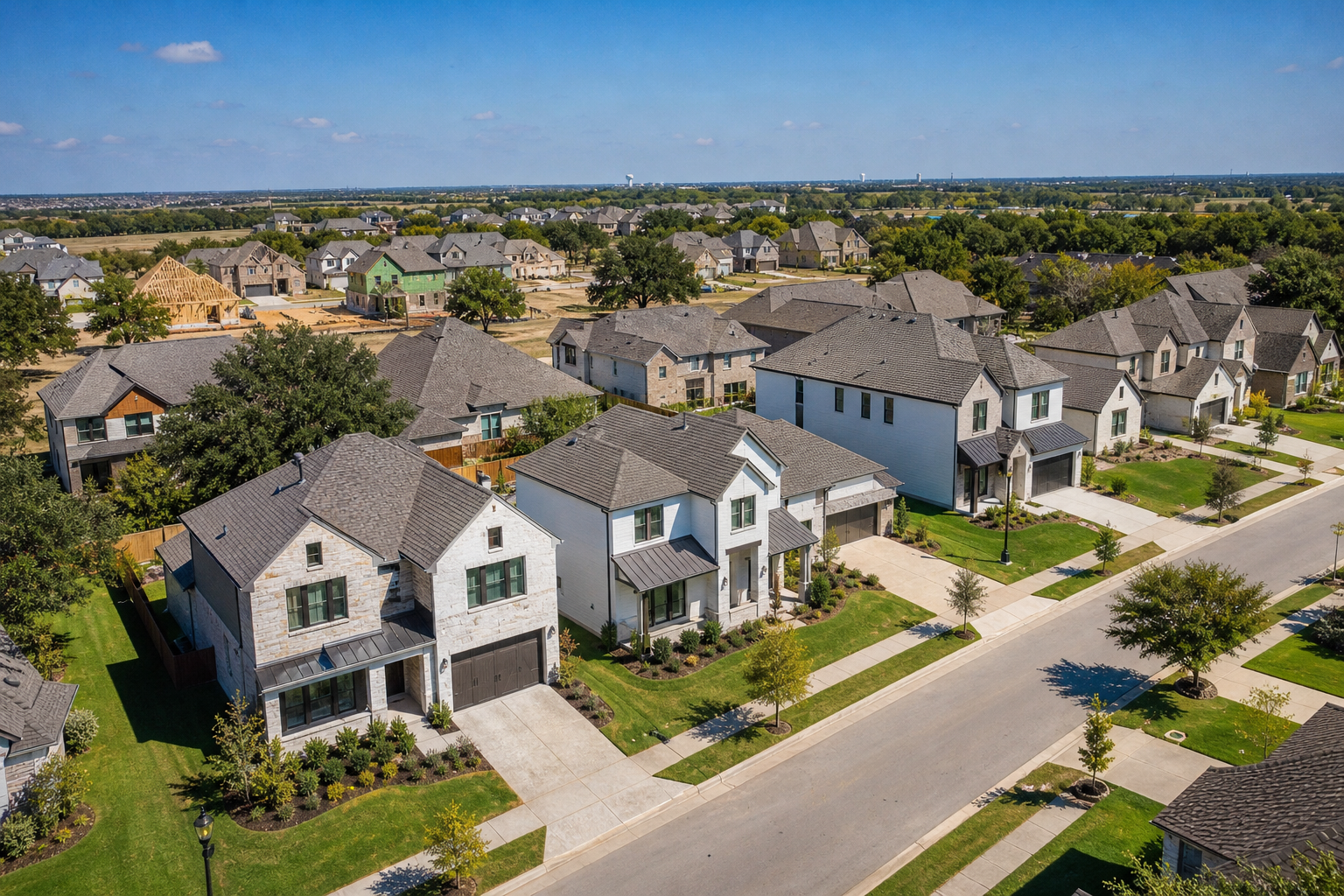
With more new-construction inventory hitting the Dallas-Fort Worth market while buyer activity drops, is this finally your window to get a better deal on a newly built home?
DFW builders added inventory month over month heading into fall 2026, but pending new-home sales fell for the fifth straight month. That gap between supply and demand is creating more choices for buyers, though it does not automatically mean deep discounts are waiting.
Why This Matters Right Now in Dallas-Fort Worth
If you’ve been watching the Dallas-Fort Worth real estate market and wondering whether the tide is shifting, the latest numbers confirm that something meaningful is happening. According to the HomesUSA.com October 2026 report, active new-home listings in DFW rose to 9,140, up 2.3% from September 2026. At the same time, pending sales dropped to 1,878, down 19.1% from October 2025.
That’s a significant gap between how many homes builders have available and how many buyers are actually putting homes under contract. For anyone who felt squeezed out of previous market conditions, this divergence matters. But here’s the nuance we always want to share with our clients: more inventory and fewer contracts do not automatically translate into fire-sale pricing. The average new-home price in DFW sat at $464,684 in October 2026, down just 0.7% year over year per the same HomesUSA.com report. So what does this environment actually look like on the ground? Let’s walk through it.
How DFW New Home Inventory Is Shifting in Late 2026
The headline sounds dramatic: more new homes, fewer buyers. But when you look at the actual numbers, the picture is more nuanced than a simple “buyer’s market” label suggests.
According to HomesUSA.com’s October 2026 report (which uses three-month moving averages of MLS-submitted data), active new-home listings in Dallas-Fort Worth reached 9,140. That’s 202 more listings than September 2026’s 8,938. However, that total was still 1.3% below October 2025’s 9,259 active listings. So while builders added inventory month over month, we haven’t surpassed where things stood a year ago.
What I tell our buyers is this: think of it as a modest monthly uptick within a market that’s still running slightly below last year’s levels. You have more to look at than you did in September, but this is not a flood of unsold homes sitting empty.
Meanwhile, new-home sales averaged 1,657 in October 2026, down 2.6% from September and down 13.8% from October 2025’s 1,922, per the same report. Pending sales tell an even sharper story, falling 6.7% month over month and 19.1% year over year. Since pending sales measure homes going under contract, they serve as a leading indicator of where closed sales are heading.
What does that feel like in practice? You may find yourself as one of fewer shoppers walking through a model home on a Saturday afternoon. That alone changes the dynamic.
Are Dallas-Fort Worth New Home Prices Actually Falling?
This is one of the most common questions we hear, and the honest answer might surprise you. The average new-home price in DFW was $464,684 in October 2026, according to the HomesUSA.com report. That’s down only 0.2% from September 2026’s $465,663 and just 0.7% below October 2025’s $467,986.
Here’s the number that really tells the story: the sales-to-list-price ratio held at 97.48% in October 2026. That was nearly identical to September 2026’s 97.50% and October 2025’s 97.45%. In dollar terms, if you’re looking at a home listed at that $464,684 average, a 97.48% ratio suggests a typical closing price around $453,000, roughly $11,700 below list. That’s a regional average for illustration, not a guarantee for any specific home or builder.
So no, builders in Dallas-Fort Worth are not broadly slashing prices. The data simply doesn’t support that narrative. What I see happening is more subtle: builders in slower markets often compete through incentive packages rather than headline price cuts — and that general pattern may apply here, though specific offers vary by builder and community. And that distinction matters enormously for how you shop.
What Dallas-Fort Worth Builder Incentives Really Look Like
Because prices are holding relatively firm, builders may look for ways to attract buyers without lowering published prices.
Common builder incentive strategies can include:
- Closing-cost assistance that reduces what you bring to the closing table
- Mortgage rate buydowns that lower your monthly payment for the first few years or potentially the full loan term
- Upgrade packages on finishes, appliances, or lot premiums
- Flexible completion timelines that may work in your favor if you’re not in a rush
One thing we always recommend to our buyers: evaluate the total financial package, not just the number on the price sheet. A builder offering $15,000 in closing-cost assistance and a rate buydown might save you more over the life of your mortgage than a $10,000 price reduction. But you need to run those numbers with your lender to know for sure.
You should also factor in HOA fees, property taxes in the specific community, insurance costs, and any long-term maintenance considerations before comparing builder offers side by side. A community in Frisco, McKinney, Allen, or Prosper will each have different tax rates and HOA structures, so the monthly cost of two identically priced homes can vary significantly depending on location.
How the DFW Resale Market Compares to New Construction
Here’s where things get interesting for buyers weighing their options across Dallas-Fort Worth. The new-construction data from HomesUSA.com tells one story, but the broader resale market is moving differently.
According to Texas Housing Insight from November 2026, DFW overall MLS active inventory (new and resale combined) was down 6% year over year as of September 2026. New-listing activity on the resale side declined 2.0% year over year through September 2026, making DFW the weakest large Texas metro for seller participation. Compare that with inventory gains reported in Austin, Houston, and San Antonio during the same period, per TRERC data.
So while new-construction inventory ticked up month over month, resale inventory actually tightened. That creates an unusual dynamic: if you’re only looking at existing homes, your choices may feel more limited than they did a year ago. But if you’re open to new construction, you may find builders with more available homes and potentially more willingness to negotiate on terms.
Within DFW, price performance also diverged by sub-market through September 2026. Per TRERC’s November 2026 report, Dallas continued to see mild year-over-year price softening, while Fort Worth showed signs of modest stabilization through September 2026. That means your experience as a buyer can vary meaningfully depending on whether you’re looking in Richardson, Plano, Mesquite, or Fort Worth.
One broader data point worth noting: through April 2026, 61% of DFW closed sales settled at prices at least 3% below the seller’s initial asking price, up from 55% two years earlier, according to TRERC’s Summer 2026 analysis. The typical DFW seller was cutting prices by 4.1% from the original asking price through April 2026, per the same source. That trend applies to the broader MLS market, not specifically to new construction, but it confirms that negotiation room has been present on the resale side of the market.
What DFW Buyers Should Do With This Information
If you’re actively shopping for a home in Dallas-Fort Worth right now, whether in Dallas, Plano, Allen, Frisco, McKinney, or Fort Worth, here’s how we’d suggest approaching this market:
- Compare new construction and resale side by side. With new-home inventory up month over month and resale inventory tighter, you may find that one path offers better value depending on your priorities. Consider warranties, modern floor plans, builder incentives, and completion timelines on the new-construction side. Weigh established neighborhoods, mature landscaping, larger lots, and potentially shorter closing timelines on the resale side.
- Don’t assume discounts are automatic. The 97.48% sales-to-list-price ratio from the HomesUSA.com October 2026 report shows buyers are still paying close to asking price on average. Approach negotiations with realistic expectations grounded in data.
- Ask about the full incentive package. Rate buydowns, closing-cost credits, and upgrade packages can be more valuable than a modest price reduction. Run the numbers with your lender before deciding.
- Pay attention to timing. New homes averaged 130 days on market in October 2026, per the HomesUSA.com report, compared with 150 days in October 2025, though the mix of homes sold can change seasonally, so this figure should be interpreted with appropriate caution.
- Understand the long-run demand story. Between 2020 and 2024, more than 517,000 people moved into the DFW Metroplex, representing over 35% of Texas’ net migration, according to TRERC’s Winter 2026 analysis. That population growth established a long-run demand base that has supported builder activity in the region. The long-term demand base hasn’t disappeared; buyer activity has cooled.
Frequently Asked Questions
Are there more new homes for sale in Dallas-Fort Worth right now?
Active new-home listings rose to 9,140 in October 2026, up 2.3% from September 2026, per the HomesUSA.com October 2026 report. However, that number was still 1.3% below October 2025’s level. So inventory is increasing month over month, but it hasn’t surpassed where things stood a year ago. You have more to browse than last month, which is a meaningful shift for active shoppers.
Is now a good time to buy new construction in DFW?
Pending new-home sales fell 19.1% year over year in October 2026, per the HomesUSA.com report, which means fewer buyers are competing for available homes. That can give you more time to compare communities, negotiate terms, and make a decision without the urgency that defined earlier years. Whether the timing is right depends on your personal finances and goals.
Are new-home prices dropping in Dallas-Fort Worth?
Not significantly. The average new-home price was $464,684 in October 2026, down just 0.7% from October 2025, according to the HomesUSA.com October 2026 report. The sales-to-list-price ratio of 97.48% confirms buyers are paying close to asking price on average. Regional averages can mask community-level variation, so your experience may differ.
Can you negotiate with homebuilders in Dallas?
You can, and a slower pace of pending sales may create more willingness from builders to offer favorable terms. However, negotiation in new construction often looks different from resale. Builders may offer closing-cost assistance, rate buydowns, or upgrade packages rather than reducing the published price. We always recommend evaluating the complete financial picture.
What builder incentives should I ask about?
Focus on closing-cost contributions, mortgage rate buydowns, included upgrades, lot premium waivers, and flexible completion timelines. Each of these can meaningfully affect your total cost or monthly payment. The specific incentives available vary by builder and community, so compare offers across multiple developments.
How does new construction affect existing home sellers in DFW?
If you’re selling an existing home near active builder communities, your competition includes new homes with warranties, modern finishes, and builder financing packages. Per the HomesUSA.com October 2026 report, builders had 9,140 active listings across DFW. Sellers should understand what nearby builders are offering so they can price and present their home competitively.
Is DFW’s overall housing market slowing down?
In Q3 2026, the Dallas-Fort Worth-Arlington area recorded fewer closed sales year over year, while some other large Texas metros posted gains, according to Texas REALTORS’ Q3 2026 press release. DFW overall MLS active inventory was down 6% year over year as of September 2026, per TRERC’s November 2026 report. The market isn’t crashing, but it is adjusting.
How long do new homes take to sell in Dallas-Fort Worth?
New homes averaged 130 days on market in October 2026, compared with 150 days in October 2025 and 129 days in September 2026, per the HomesUSA.com October 2026 report. The year-over-year improvement is notable, though the mix of homes sold can change seasonally, so this comparison should be interpreted with appropriate caution.
Is it better to buy new construction or a resale home in DFW?
It depends on your priorities. New construction offers modern floor plans, builder warranties, and potential incentive packages. Resale homes may offer established neighborhoods, mature landscaping, and potentially faster move-in timelines. With new-construction inventory rising and resale inventory tighter in DFW, comparing both options side by side makes more sense than ever.
How is DFW different from other Texas housing markets right now?
DFW stands out as the weakest large Texas metro for resale new-listing activity, with listings down 2.0% year over year through September 2026, according to TRERC’s November 2026 report. Overall DFW active inventory (new and resale combined) fell 6% year over year, while Austin, Houston, and San Antonio each saw inventory increases during the same period. That means DFW’s supply dynamics differ meaningfully from the rest of the state.
The Bottom Line
The Dallas-Fort Worth housing market in 2026 is giving you something it hasn’t in a while: breathing room. More builder inventory month over month, fewer buyers competing for contracts, and a pace that lets you compare communities across Plano, Allen, Frisco, McKinney, Fort Worth, and beyond without feeling rushed. But breathing room is not the same as a clearance sale. Prices are holding firm, and the sales-to-list ratio shows buyers are still paying close to asking.
The opportunity here is in the details: comparing builder incentive packages, weighing new construction against resale options, and making a decision based on your complete financial picture rather than headlines. That’s exactly where we come in. At Unlocking DFW Realty, we help buyers navigate these choices every day across Dallas-Fort Worth. Jamie Simpson is a certified New Home Sales Agent and Real Estate Negotiation Expert, recognized by D Magazine as a Best Real Estate Agent since 2020.
Contact Jamie Simpson, Unlocking DFW Realty: call 2145098094, email jamie@unlocking-dfw.com, or visit unlocking-dfw.com.

Leave a Reply