When you’re buying a home in the Dallas-Fort Worth Metroplex, should you research what’s being built nearby before making an offer?
Absolutely. A home is also the neighborhood surrounding it, and new construction, road projects, or commercial developments nearby can change your daily life, your property value, and the character of your community for years to come.
Why Nearby Development Research Matters Right Now in DFW
The Dallas-Fort Worth Metroplex sits in one of the most actively built regions in the country. Nationally, building permits were issued at a seasonally adjusted annual rate of 1,400,000 in September 2026, according to the U.S. Census Bureau and HUD. The South Census region, which includes Texas, has consistently led the nation in new residential construction volume. That means DFW buyers are operating in one of the most actively built metro areas in the country, making development research especially important for any home they consider.
At the same time, the Dallas-Fort Worth real estate market is giving you more breathing room to do your homework. Texas statewide average days on market reached 80 days in Q1 2026, per Texas REALTORS, which is six days longer than the same period in 2025. Statewide months of inventory climbed to approximately 5 months in Q1 2026, a level analysts at the Texas Real Estate Research Center characterize as a balanced market. You have time to investigate. Use it.
What does that actually mean for your search? It means you do not have to rush into a decision before understanding the full picture of what is happening around a property. And in a market this active with construction, that full picture matters more than most buyers realize.
How New Development Changes a DFW Neighborhood
We always encourage buyers to look beyond the house itself and pay attention to what is happening in the surrounding community. It is easy to fall in love with a kitchen, a backyard, or a price point and forget that you are also buying into a neighborhood that may look very different in two or three years.
New construction can reshape a neighborhood in several ways:
- Residential projects like apartment complexes, townhome communities, or new single-family subdivisions add density, bring more residents, and can change traffic patterns on streets you would use every day
- Commercial and retail development including shopping centers, restaurants, and office parks can bring convenience but also noise, light, and increased vehicle traffic
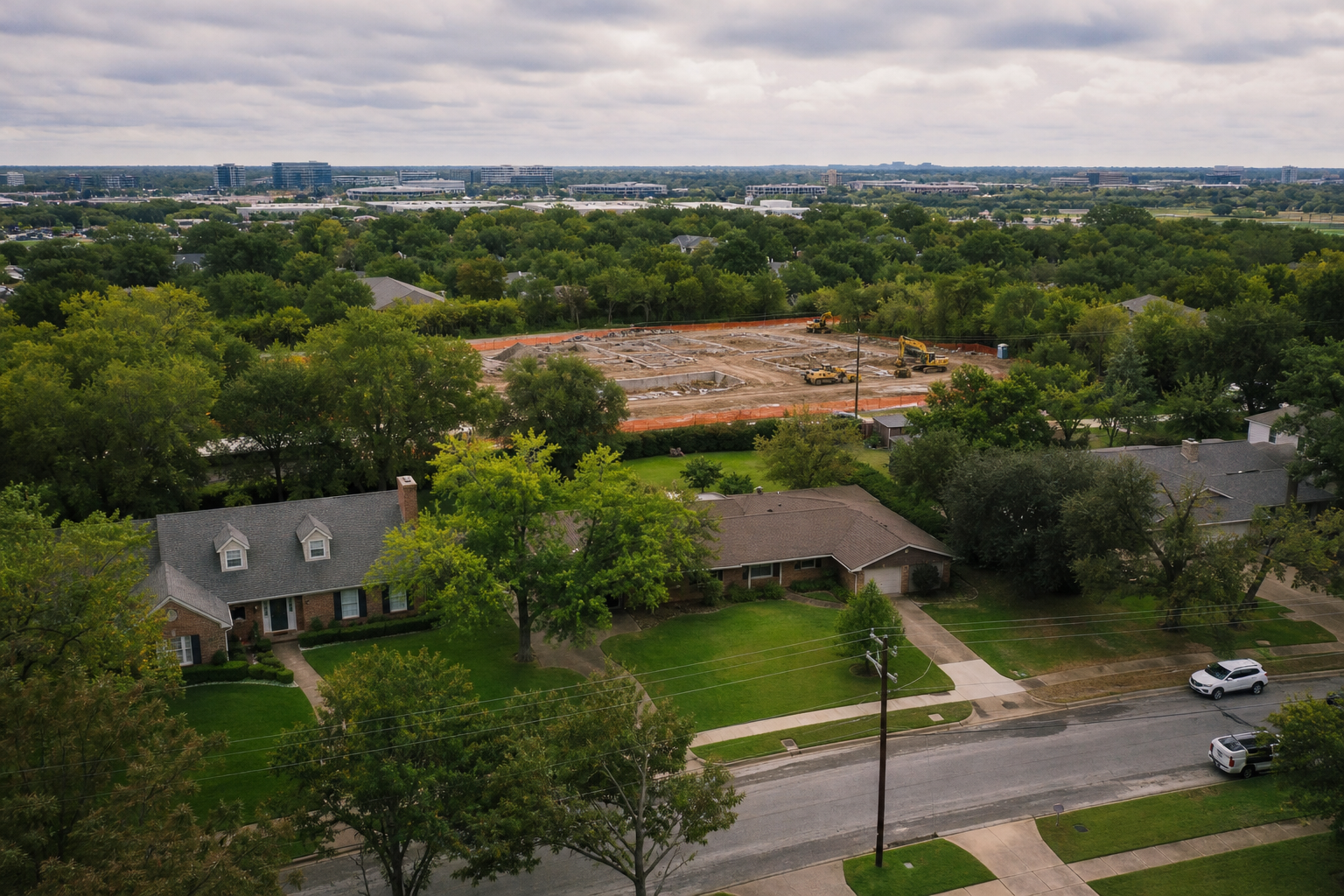
- Infrastructure projects such as road expansions, highway interchanges, and utility corridors may improve long-term connectivity but create significant temporary disruption
- Institutional projects like schools, hospitals, and government facilities can anchor a neighborhood positively but also draw large volumes of visitors and parking demand
In my experience working with buyers across Dallas and the surrounding suburbs, the mistake I watch buyers make most often is evaluating a house in isolation. The layout may be perfect. The price may feel right. But if a large apartment development is approved for the vacant lot next door, or a road widening project is planned for the street out front, those factors will affect both your quality of life and your resale value down the road.
So how do you find out what is planned before you commit?
Where to Research Development Activity in the Dallas-Fort Worth Metroplex
One of the most empowering things you can do as a buyer, especially if you are relocating to DFW or buying your first home, is to learn that development information is public. You just need to know where to look.
Dallas City Limits
If your property falls within the City of Dallas, the City of Dallas Development Services Department maintains a public online portal where you can search permit filings, zoning cases, and plan review status. Search for “City of Dallas Development Services permit search” to access it. This is your primary resource for understanding what has been filed, approved, or permitted near a property you are considering.
Fort Worth City Limits
For properties within Fort Worth, the City of Fort Worth Development Services division provides a similar online permit and inspection search tool. You can search for it directly through the City of Fort Worth’s website.
The Northern Growth Corridor
DFW’s northern suburbs, including Frisco, McKinney, Allen, Prosper, and Celina, represent some of the most actively permitted suburban areas in the country. Each municipality operates its own development portal. This is important because city boundaries in this corridor can shift within a single neighborhood or even within a single subdivision. You need to confirm which city’s jurisdiction your property falls under before searching for permits.
Road and Highway Projects
The Texas Department of Transportation, known as TxDOT, maintains a project tracker for highway and road construction across the state. This is especially relevant if you are looking at homes near major DFW corridors such as US-380, SH-121, SH-114, or the Dallas North Tollway extension areas.
Having closed over 148 transactions and working as a certified New Home Sales Agent, we know firsthand that many buyers, especially first-time buyers and relocation clients, have no idea these tools exist. That is why we make this part of the process for every buyer we work with.
Understanding the Four Stages of a DFW Development Project
One thing we always want buyers to remember is that not every development announcement means a project is ready to move forward. There is a meaningful difference between these four stages:
- Proposed: Someone has submitted an idea or application, but no approval has been granted. Some proposed projects never advance beyond this stage.
- Registered construction filing: A formal filing has been made with the city, but the project has not yet been approved. It is in the review pipeline.
- Approved: The project has received the necessary approvals and permits. It is cleared to proceed, but construction may not begin for months or even years.
- Under construction (broken ground): Heavy equipment is on site and work is actively underway. This is the only stage where you can be certain the project will affect the neighborhood in the near term.
Why does this distinction matter so much? Because a “proposed” project on a zoning map can look alarming, but it may never materialize. Conversely, an “approved” project that seems quiet today could break ground the month after you close. When you check a city permit portal, pay attention to where a project sits in this progression. It changes how much weight you should give it in your decision.
This is one of the areas where working with an experienced local agent makes a real difference. With 6 years of experience and recognition as a D Magazine Best Real Estate Agent since 2020, we have seen how projects move through these stages across Dallas, East Dallas, and the broader DFW market, and we can help you interpret what a zoning case or permit filing actually means for the house you are considering.
Temporary Disruptions vs. Permanent Changes in Your DFW Neighborhood
Not all construction impacts are the same, and it is worth separating the temporary from the permanent when you are evaluating a property.
Temporary Impacts
Active construction brings disruptions that typically resolve once a project is complete:
- Noise from heavy equipment and construction crews, often starting early in the morning
- Dust and debris, especially during site grading and foundation work
- Increased truck traffic on residential streets
- Altered access routes, detours, or road closures
- Reduced street parking in the immediate area
These are real inconveniences, but they have an end date. When you check a project’s construction timeline through the city portal, you can estimate how long these disruptions will last and decide whether you are comfortable living through them.
Permanent Changes
What remains after the construction crews leave is what matters for your long-term investment:
- A high-density apartment building adjacent to a single-family street
- A new arterial road that changes traffic flow through your neighborhood
- A commercial anchor that shifts the character of a nearby corridor
- A school or hospital campus that generates ongoing visitor traffic
The permanent outcome is what you need to evaluate most carefully. A year of construction noise is manageable if the finished project improves your neighborhood. But if the permanent change adds density, congestion, or commercial activity you did not anticipate, that affects both your daily routine and your future resale prospects.
Your DFW Development Research Checklist Before Making an Offer
Here is the practical, step-by-step approach we recommend to every buyer before committing to a home in the Dallas-Fort Worth Metroplex:
- Identify the correct municipality. Confirm whether the property falls within Dallas, Fort Worth, or one of the surrounding cities. In the northern growth corridor especially, this is not always obvious.
- Search the city’s permit and zoning portal. Look up the property address and scan for active permits, zoning cases, or plan reviews in the surrounding area.
- Check the project’s current status. Is it proposed, approved, permitted, or under active construction? This tells you how likely and how soon it will affect you.
- Note the project type and estimated timeline. A six-month road resurfacing project is very different from a three-year mixed-use development.
- Drive the surrounding streets at different times of day. Morning rush, midday, and evening will each reveal different traffic patterns and activity levels. If you are relocating and cannot visit in person, ask your agent to drive the area and report back.
- Ask about planned road or utility projects. Contact the listing agent or the municipality directly. TxDOT’s project tracker can help you identify highway-level work planned near the property.
With first-time buyers accounting for 21% of Texas home purchases according to the 2026 Texas Homebuyers and Sellers Report, many buyers going through this process have never done it before. That is completely normal. The key is knowing these resources exist and building this research into your timeline.
Comparing Established DFW Neighborhoods with High-Growth Areas
If you are weighing an established East Dallas neighborhood against a rapidly growing suburb like Prosper or Celina, the development research equation looks different in each.
Established neighborhoods in Dallas and Fort Worth tend to offer more predictability. That said, infill development can still bring meaningful change, so you should still check permit portals even in mature neighborhoods.
High-growth suburban areas offer strong appreciation potential, but they come with more construction uncertainty. Vacant land around your property could become a subdivision, a retail center, or a school campus. The upside is that many of these developments bring amenities, improved infrastructure, and community investment. The trade-off is that you may live through several years of active construction as the area fills in.
Neither option is inherently better. What matters is that you understand what you are buying into. A more informed buyer is a more confident buyer, and that is what we aim for with every client at Unlocking DFW Realty.
Frequently Asked Questions About DFW Development Research
How do I find out what is being built near a home I want to buy in Dallas?
Search the City of Dallas Development Services Department’s public permit portal. You can look up permit filings, zoning cases, and plan review status by address. If the property falls outside Dallas city limits, check the permit portal for the specific municipality where the home is located. Your real estate agent can also help you identify the right jurisdiction.
Does new construction nearby hurt or help my home’s value in DFW?
It depends on the type of project. Infrastructure improvements and well-designed retail or community amenities can support property values. High-density residential projects directly adjacent to single-family homes may raise concerns for some buyers. The key is understanding what specifically is being built and how it fits the neighborhood’s trajectory.
What is the difference between a proposed project and one that has broken ground?
A proposed project is an application or concept that has not yet been approved. Some proposals never advance. A project that has broken ground is actively under construction — this is the stage at which impact on the neighborhood is certain in the near term.
Should I worry about construction noise if I buy near an active building site in DFW?
Construction noise is a temporary disruption that typically resolves once the project is completed. Before buying, check the project’s estimated timeline through the city’s permit portal so you can gauge how long disruptions may last. Driving the area during active construction hours can also help you assess the current noise level.
How long does a typical development project take near DFW neighborhoods?
Timelines vary widely. Check the project’s permit filing for an estimated completion date, and keep in mind that construction timelines often extend beyond initial projections.
Where can I check for planned road construction near a DFW home?
TxDOT maintains a project tracker for state highway and road projects across Texas, which covers major DFW corridors. For local road projects, check the public works or transportation department for the city where the property is located. This is especially important near heavily traveled routes like US-380, SH-121, and SH-114.
Are DFW suburbs like Frisco and McKinney still seeing a lot of new construction in 2026?
DFW’s northern growth corridor, which includes Frisco, McKinney, Allen, Prosper, and Celina, remains among the most actively permitted suburban areas in the country. If you are buying in these areas, development research is especially critical because vacant land near your property may already have approved projects in the pipeline.
Can my real estate agent help me research nearby development in Dallas-Fort Worth?
Yes, and we strongly recommend working with an agent who makes this part of the buying process. At Unlocking DFW Realty, with 84 five-star reviews and a Real Estate Negotiation Expert (RENE) certification, we build development research into our buyer consultations because we believe the neighborhood matters as much as the home itself.
What types of development should I research before buying a home in DFW?
At a minimum, look into residential construction (subdivisions, apartments, townhomes), commercial and retail development, infrastructure projects (roads, utilities, highway interchanges), and institutional projects (schools, hospitals, government facilities). Each type carries different implications for noise, traffic, density, and long-term neighborhood character.
How does DFW’s current market give me more time to research development?
With the Texas statewide average days on market at 80 days in Q1 2026, per Texas REALTORS, and inventory at approximately 5 months statewide in Q1 2026, you generally have more time than in recent years to conduct development research before making a decision. Use that breathing room to check permit portals, drive the neighborhood, and ask the right questions.
The Bottom Line
A home is more than the structure you purchase. It is also the neighborhood and community you become part of. In a metro as actively built as Dallas-Fort Worth, understanding what is happening around a property is one of the most important steps you can take before making an offer. Check the city’s permit portal. Understand the project’s stage. Distinguish temporary construction disruption from permanent neighborhood change. And drive the surrounding streets yourself.
At Unlocking DFW Realty, we help buyers do exactly this. With over 148 closed transactions, a 5 out of 5 star rating across 84 reviews, and recognition as a MetroTex 40 Under 40 honoree and D Magazine Best Real Estate Agent, we bring deep local knowledge to every search. If you are looking at homes for sale in Dallas TX or anywhere across the DFW real estate market, reach out to us at 214-509-8094 or visit Unlocking DFW Realty. We will help you see the full picture, not just the house.

Leave a Reply