


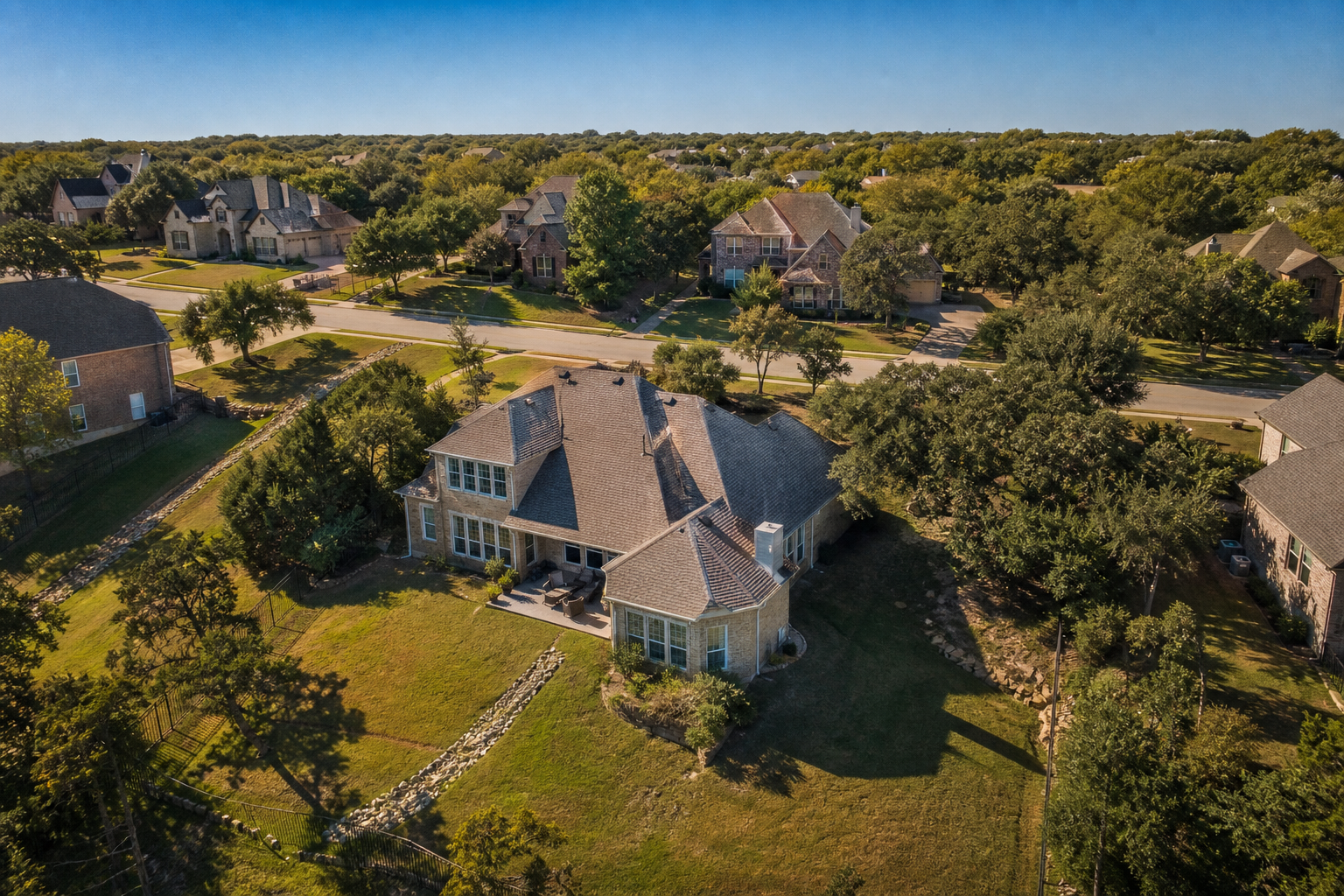
What weather-related factors should you evaluate before buying a home in the Dallas Fort Worth Metroplex?
North Texas weather brings intense heat, severe thunderstorms, hail, and flash flooding that directly affect your home’s long-term performance and cost of ownership. Before you buy, you need to research flood zones, evaluate drainage, inspect roofing and HVAC systems, and budget for weather-driven maintenance beyond your monthly mortgage.
Why This Matters Right Now in the Dallas Fort Worth Metroplex
Here is a perfect example of why weather awareness matters for DFW buyers. As of October 7, 2026, Dallas Fort Worth is sunny, warm, and completely dry, with highs in the mid-to-upper 80s and morning lows in the mid-60s, according to FOX 4’s Ali Turiano. It feels like a perfect day to tour homes.
High pressure over Texas is currently keeping moisture south and east of North Texas.
What does that contrast tell you? We at Unlocking DFW Realty see this pattern repeatedly. The weather on the day you tour a property tells you almost nothing about what that home will face over the next 10, 20, or 30 years. A home purchase is a multi-decade commitment, and your due diligence needs to go far beyond blue skies.
How Flood Risk Affects Dallas Fort Worth Home Buyers
Flooding is one of the most misunderstood risks in the Dallas real estate market. Many buyers assume that if a home is not in a designated flood zone, it is safe. That assumption can be costly.
The Trinity River Watershed and Your Property
The Trinity River watershed is the primary flooding source system for Dallas County. Its named tributaries, including White Rock Creek, Turtle Creek, Elm Fork, and West Fork, are all studied in FEMA’s Dallas County Flood Insurance Study. The Dallas Floodway itself consists of approximately 23 miles of levees protecting roughly 10,500 acres near the confluence of the Elm Fork and West Fork in the heart of Dallas. Those levees were completed in May 1960, and some levees in the southern part of Dallas County are rated insufficient to contain the 1-percent-annual-chance flood.
Why Being Outside a Flood Zone Does Not Mean Zero Risk
According to FEMA, more than 25% of flood damages occur outside designated Special Flood Hazard Areas. That means even if a property sits outside the lines on the map, it can still flood.
So what should you actually do? Before you make an offer on any home in the Dallas Fort Worth Metroplex, look up that specific address on the FEMA Flood Map Service Center at msc.fema.gov. The current effective Flood Insurance Rate Maps for Dallas County and the City of Dallas date to March 21, 2019, per FEMA’s data tables. Fort Worth and Tarrant County maps have had preliminary revisions open for public comment as recently as July through October 2021, covering cities including Arlington, Euless, Grand Prairie, Grapevine, Keller, Mansfield, North Richland Hills, and Southlake. Even Parker County on the western fringe of the metroplex saw preliminary FIRMs released in February 2025 covering Aledo, Azle, Weatherford, and Willow Park.
What I tell buyers is this: maps get revised. A property that was in a low-risk zone five years ago may have been reclassified. Always pull the current map yourself rather than relying solely on a seller’s disclosure.
Why Dallas Fort Worth Drainage Can Matter More Than the Forecast
Two homes in the same DFW neighborhood, experiencing the exact same rainfall, can have dramatically different outcomes. Factors that can contribute include grading, drainage, lot characteristics, and surrounding development, among others.
What to Evaluate During Your Property Tour
When you walk a property, look beyond the cosmetic details. Here is what we recommend checking:
- Lot grading: Does the ground slope away from the foundation on all sides, or does water have a path toward the home?
- Gutters and downspouts: Are they present, functional, and directing water away from the foundation?
- Neighboring properties: Is your potential home sitting lower than surrounding lots? Water flows downhill, and it does not respect property lines.
- Drainage easements and channels: Look for evidence of standing water, erosion patterns, or silt deposits near the foundation and in the yard.
- Foundation condition: North Texas sits on expansive clay soils that shift with moisture changes. Cracks, uneven floors, and sticking doors can signal foundation movement caused by inconsistent drainage.
Having closed over 148 transactions across the DFW market, we have learned that drainage issues rarely announce themselves on a sunny day. A property inspection during or shortly after heavy rain reveals far more about how a home actually handles weather than any clear-sky walkthrough ever will.
Insurance Gaps That Catch Dallas Fort Worth Buyers Off Guard
Here is something that surprises many first-time buyers and relocators: standard homeowners insurance policies in Texas generally do not cover flood damage. FEMA has stated this explicitly. If your home floods, your standard policy will likely not pay the claim.
What You Need to Know About Flood Insurance in DFW
- If your property is in a Special Flood Hazard Area, your mortgage lender will generally require you to carry flood insurance.
- If your property is outside a designated SFHA, flood insurance is typically optional, but given that more than 25% of flood damages occur outside those zones, carrying a policy can be a smart financial decision.
- National Flood Insurance Program (NFIP) policies are available through participating insurers. Private flood insurance options also exist and may offer different coverage limits.
Before you close on any Dallas Fort Worth property, ask your insurance agent specifically about flood coverage. This is not a question you want to answer after a storm.
The July 2025 federal disaster declaration (DR-4879-TX) for Texas severe storms, straight-line winds, and flooding makes this point in real dollars. According to FEMA, that event resulted in 3,883 approved individual assistance applications and over $41.4 million in individual assistance, with more than $330 million in public assistance obligations statewide, as of July 2025. Weather-related property risk in Texas is not theoretical.
Weather-Driven Maintenance Costs DFW Buyers Should Budget For
Your monthly mortgage payment is only part of what it costs to own a home in the Dallas Fort Worth Metroplex. Census Bureau ACS data (2020–2024) shows median monthly owner costs of approximately $2,316 in Dallas and $2,188 in Fort Worth for mortgaged homeowners — figures that provide a sense of scale for ownership costs in this price range, though current costs may differ. Those figures do not capture the weather-driven maintenance that North Texas demands.
The Maintenance Costs That Surprise New Homeowners
- HVAC servicing: DFW summers push air conditioning systems hard. Regular maintenance and eventual replacement are part of ownership, not optional extras.
- Roof inspection after hail events: North Texas experiences hail events. After significant storms, you should have your roof inspected for damage that may not be visible from the ground.
- Foundation monitoring: Expansive clay soils expand when wet and contract when dry. Consistent watering around your foundation and proper drainage management help minimize movement over time.
- Exterior caulking and paint: Intense UV exposure, temperature swings, and driving rain all degrade exterior finishes faster than you might expect if you are relocating from a milder climate.
- Gutter and drainage upkeep: Heavy spring and fall storms can overwhelm clogged or poorly maintained gutter systems quickly.
What I consistently recommend to first-time buyers and relocating clients is to set aside a dedicated maintenance budget from day one. We are not talking about cosmetic upgrades; we are talking about protecting your investment from the specific conditions North Texas delivers year after year.
What Features Make a Dallas Fort Worth Home More Weather-Resilient
Not all homes perform equally through DFW weather extremes. When you are comparing properties, certain features can make a meaningful difference in your comfort and your long-term costs.
Key Features to Prioritize
- Impact-resistant roofing materials: These are designed to reduce the likelihood of hail damage and may be worth discussing with your insurance agent regarding any available discounts.
- Proper attic insulation and ventilation: In a climate where summer temperatures regularly approach triple digits, these features directly affect your energy bills and HVAC lifespan.
- Mature trees providing shade: Shade on the south and west sides of a home can reduce cooling costs, but trees also need to be evaluated for storm damage risk.
- Updated windows and sealing: Older single-pane windows lose energy efficiency and can be vulnerable in high winds.
- A home’s age and construction type: Newer construction in the DFW area often incorporates updated building codes, but older homes may have more established drainage patterns. Neither is automatically better; both require evaluation.
With 6 years of experience working the DFW market and recognition as a D Magazine Best Real Estate Agent since 2020 and a MetroTex 40 Under 40 honoree, we have walked through hundreds of properties in every kind of weather. The features that matter most are the ones you often cannot see in listing photos.
Relocating to Dallas Fort Worth? What Your Previous Climate Did Not Teach You
If you are moving to the Dallas Fort Worth Metroplex from another part of the country, your frame of reference for “weather” may not prepare you for North Texas. The combination of intense summer heat, expansive clay soils, powerful thunderstorms, and occasional tornado activity creates a set of homeownership considerations that are specific to this region.
The mistake we watch buyers make here is assuming that a home inspection alone covers everything. A standard inspection is essential, but it typically evaluates a property’s current condition. It does not necessarily tell you how that property will perform through years of DFW weather cycles.
What we recommend for relocating buyers is layering your research. Start with the property inspection, then check the FEMA flood map, then talk to your insurance agent about both standard and flood coverage, then ask specifically about drainage and foundation history. Each of those steps addresses a different piece of the weather picture.
Rated 5 out of 5 stars across 84 client reviews, our team at Unlocking DFW Realty works extensively with relocation clients. Understanding local weather considerations is one of the most practical things we can help you prepare for.
Frequently Asked Questions
Does buying a home in a DFW flood zone mean I should walk away?
Not necessarily. A flood zone designation tells you about statistical risk, not certainty. What matters is understanding how the designation affects your insurance requirements and costs, evaluating the specific property’s drainage and elevation, and making an informed decision. Many excellent DFW properties sit in or near flood zones; just know what you are buying into.
How do I check a specific DFW property’s flood risk before making an offer?
You can look up any address on the FEMA Flood Map Service Center at msc.fema.gov. This free tool shows the current flood zone designation for a specific property. For Dallas County properties, the effective maps date to March 21, 2019 per FEMA’s data tables. We recommend checking this before writing your offer, not after.
Does standard homeowners insurance in Texas cover flood damage?
In most cases, no. FEMA has stated that standard homeowners insurance policies generally do not cover flood damage. You need a separate flood insurance policy, available through the National Flood Insurance Program or private insurers. Ask your insurance agent about this well before closing day.
What weather-related maintenance should I budget for as a DFW homeowner?
Plan for regular HVAC servicing, periodic roof inspections after hail events, foundation moisture management on clay soils, gutter cleaning, and exterior maintenance including caulking and paint. These costs go beyond the median monthly owner costs of roughly $2,316 in Dallas and $2,188 in Fort Worth reported in Census Bureau ACS data from 2020 through 2024.
How does North Texas clay soil affect foundations?
Expansive clay soils swell when wet and shrink when dry. This cycle creates soil movement that can stress foundations over time, causing cracks, uneven floors, and sticking doors. Consistent moisture management around your foundation, through proper drainage and sometimes supplemental watering, helps minimize this movement.
Should I schedule a home inspection during or after rain in DFW?
Touring a property during or shortly after heavy rain can reveal drainage problems, standing water, and leak issues that are invisible on a dry day. While you cannot always control timing, we recommend at minimum driving by the property after a significant rain event before finalizing your purchase.
Are FEMA flood maps for DFW updated regularly?
FEMA revises flood maps as new hydrologic studies are completed. Tarrant County had preliminary maps open for public comment as recently as 2021, and Parker County saw new preliminary maps released in February 2025, according to FEMA. A property’s flood zone designation can change, so always check the most current map.
What roofing materials hold up best in the Dallas Fort Worth climate?
Impact-resistant shingles are designed to withstand hail better than standard options and may qualify you for insurance premium discounts. Metal roofing is another durable option. In our experience, the age and condition of a roof matter at least as much as the material type, so always have a professional roof inspection done.
How does Tropical Storm Isaias affect DFW home buyers right now?
As of October 7, 2026, FOX 4 reports that high pressure over Texas is keeping Tropical Storm Isaias’ moisture south and east of North Texas. DFW is currently unaffected. However, the storm is a good reminder that Gulf weather systems can shift, and that your property research should account for long-term weather patterns, not just today’s forecast.
What questions should I ask my real estate agent about weather when buying in DFW?
Ask about the property’s flood zone status, drainage history, roof age and condition, HVAC system age, foundation repair history, and insurance cost estimates including flood coverage. A knowledgeable local agent, such as a Real Estate Negotiation Expert with deep DFW experience, can guide you through each of these weather-related checkpoints.
The Bottom Line
Weather is not a footnote in your Dallas Fort Worth home buying decision. It is an ongoing factor that affects your property’s performance, your insurance costs, your maintenance budget, and your family’s comfort for as long as you own the home. The sunny skies over DFW today do not change what the next 20 years of storms, heat, and clay soil movement will ask of your property.
Do your flood zone research before you make an offer. Budget for weather-driven maintenance from day one. Ask the right questions about drainage, roofing, HVAC, and foundation condition. And work with a team that understands what North Texas weather actually means for homeowners.
We are Jamie Simpson and the Unlocking DFW Realty team, and helping buyers make informed, confident decisions is what we do every day. If you are buying a home in the Dallas Fort Worth Metroplex and want a team with over 148 closed transactions and 84 five-star reviews behind them, reach out to us at 214-509-8094 or visit unlocking-dfw.com. We would love to help you find a home that performs as well in a storm as it looks on a sunny afternoon.

Leave a Reply