
What should you evaluate in a mixed-use community before buying a home in Dallas-Fort Worth?
You should assess the amenity mix against your actual daily routine, compare the full cost stack (including HOA fees and parking), verify future development plans through city records, and visit at multiple times of day to gauge noise and activity levels.
Why Mixed-Use Communities in DFW Deserve a Closer Look Right Now
Mixed-use communities are reshaping how people live across Dallas-Fort Worth, and the pace of development in 2026 makes this a conversation worth having before you start touring homes. CityLine in Richardson continues to expand its retail and dining lineup alongside anchors like Whole Foods Market and Club Pilates. In Fort Worth, Westside Village is under construction at Westside and North University drives, positioned as a gateway into Fort Worth’s urban core, per D CEO Magazine in April 2026. Addison Junction is planning a beer garden, farmers market, and walking trail on a 15-acre site near Addison Circle, also per D CEO Magazine in April 2026.
With the statewide Texas median home price at $328,000 in Q1 2026, according to Texas REALTORS, and average days on market reaching 80 days statewide in the same period, buyers have more time and more choices than in recent years. That breathing room means you can be deliberate about community type, not just price. But more choices also mean more homework. With 6 years of experience and over 148 transactions closed, we have walked buyers through this evaluation process many times, and the biggest mistake we see is falling in love with amenities on a brochure before understanding the full picture.
How to Tell if a DFW Mixed-Use Community Fits Your Daily Life
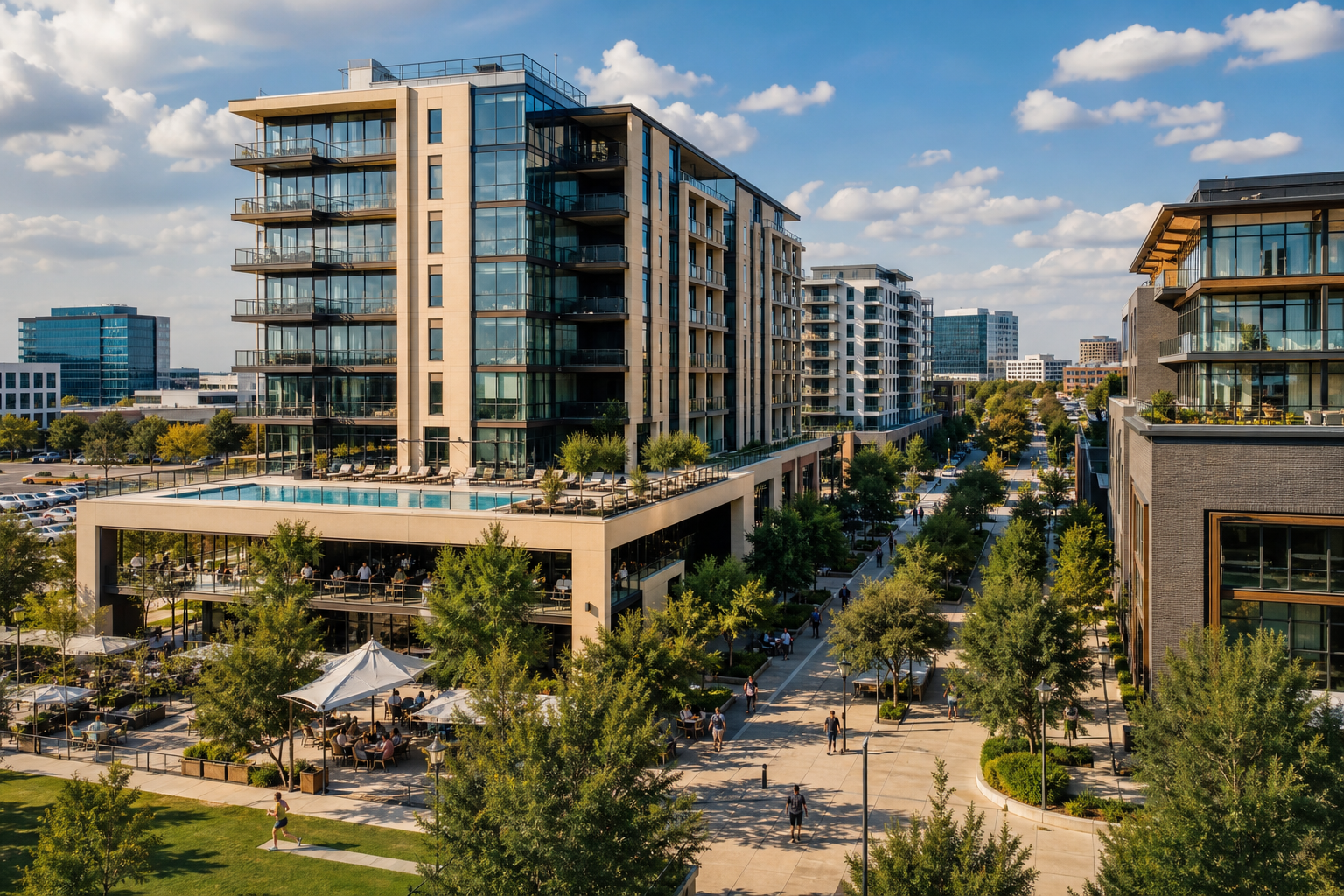
The word “mixed-use” gets thrown around a lot in Dallas-Fort Worth real estate, and it can mean very different things depending on the development. At its core, a mixed-use community integrates residential units with retail, dining, office space, and shared amenities within a walkable footprint. The idea is that you can meet daily needs without a car trip.
In practice, you need to ask: does this community actually deliver that?
Match Amenities to Your Real Routine
Before you get swept up by a rooftop pool or a co-working lounge, sit down and list the three to five amenities you use every single week. Not the ones that sound appealing on a Saturday tour; the ones you genuinely rely on. Then check whether the community delivers them.
For perspective, consider the LOCAL on Delmar project in University City, Missouri. That 259-unit, five-story development combines apartments with collaborative workspaces, street-level retail, and resident amenities near Washington University in St. Louis. It is a useful example of how developers package these elements, even though it is not in our DFW market. The takeaway for DFW buyers: look at how the amenity mix is designed and ask yourself whether you would actually use those spaces daily.
Here is what we tell our clients to check on every mixed-use community tour:
- Grocery access. Is there a full grocery store on site or within walking distance, or just a convenience shop?
- Fitness and wellness. Compare the on-site gym to what you would pay for a standalone membership.
- Co-working or office space. If you work from home, does the community’s workspace actually support focused work?
- Dining and entertainment. Are the restaurants open year-round, or do some rotate seasonally?
- Transit. CityLine in Richardson offers DART Rail access. Legacy West in Plano is anchored by major corporate campuses. These are fundamentally different daily experiences.
Understanding the Full Cost Stack in DFW Mixed-Use Districts
One of the most common traps we watch buyers fall into is comparing a mixed-use community’s purchase price against a suburban home’s purchase price and stopping there. That comparison is incomplete.
A home in a mixed-use district often carries HOA fees, parking costs, or amenity surcharges that a conventional suburban home does not. You need to add all of those to your monthly payment before drawing any conclusion.
Build Your Comparison This Way
- Start with the mortgage payment on each property.
- Add the HOA fee for the mixed-use community. These fees fund the pools, fitness centers, shared spaces, and common area maintenance.
- Add parking costs if residential parking is not included or if you need a second spot.
- Subtract the costs you would pay independently in a non-mixed-use suburb: gym membership, co-working subscription, additional gas and car maintenance for errand trips.
The statewide Texas median home price was $328,000 in Q1 2026, per Texas REALTORS. But homes in DFW’s most established mixed-use districts may carry price points above the statewide median, though your agent can pull current comparable sales to confirm what homes are actually trading for in each community. Your total monthly outlay is what matters, not the sticker price alone.
What we always recommend is running this full cost comparison on paper before your second showing. It keeps you grounded in reality when a community’s amenity list is dazzling.
Noise, Parking, and Activity Levels: The Trade-Offs Nobody Mentions on Tour Day in DFW
Mixed-use districts generate foot traffic, event programming, restaurant crowds, and commercial deliveries. That vibrancy is the whole point, but it is also the thing that can wear on you if you are not prepared for it.
Visit at Multiple Times
This is non-negotiable. Tour the community on a Tuesday morning, a Friday night, and a Sunday afternoon. You will see three very different environments. The Star in Frisco, for example, hosts events at the 12,000-seat Ford Center that can change the energy of the entire district on game nights and concert weekends. That is exciting if you love it. It is exhausting if you do not.
Ask These Specific Questions
- Is residential parking separated from retail and visitor parking, or shared?
- What are the noise policies after 10 p.m.?
- How frequently does the community host public events, and where do attendees park?
- Are there delivery hours for commercial tenants, and do those hours overlap with your sleep schedule?
The LOCAL on Delmar project in Missouri sits at the western edge of the Delmar Loop entertainment district. That proximity to nightlife and restaurants is a selling point for some residents and a source of friction for others. The same dynamic plays out in DFW. A home near CityLine’s restaurant row in Richardson or Legacy Food Hall in Plano offers convenience and activity, but you need to decide which side of that balance fits your household.
How to Verify What Is Actually Coming Next to a DFW Mixed-Use Community
Developers are storytellers. Their promotional materials describe intended uses, renderings, and future tenants. City records confirm what has actually been permitted. You need to check both, but trust the permits.
Where to Look in DFW
Every major municipality in Dallas-Fort Worth publishes zoning and permit records online. Dallas, Fort Worth, Plano, Richardson, Frisco, and Addison all maintain planning portals where you can confirm:
- What has been approved and is under construction
- What has been submitted but not yet approved
- What is still purely speculative
For example, the CityLine expansion in Richardson’s CORE District has active development underway. Check the city’s planning portal to confirm what has been permitted and what timelines have been filed. Compare that to a neighbor who tells you “they’re putting in a Whole Foods down the street” with no city filing to back it up.
As a Real Estate Negotiation Expert (RENE) and a certified New Home Sales Agent, we guide buyers through this research process regularly. We have seen developments stall, tenant lineups change, and timelines shift. What the city has permitted is your baseline. Everything else is a maybe.
Do Mixed-Use Amenities Actually Help Resale Value in Dallas-Fort Worth?
This is the question we get asked most often, and the honest answer is: it depends, and you should not assume.
Proximity to walkable retail and shared amenities can make a home more appealing to a future buyer. But that appeal only translates into a measurable price difference when supported by recent comparable sales in the same community. The 2026 Texas Homebuyers and Sellers Report, published by Texas REALTORS, found that 74% of Texas sellers reduced their asking price two or more times before closing, and cash sales hit a record 30% of transactions. Those numbers are a reminder that market conditions, not amenity lists, set the final price.
What We Tell Buyers About Resale
- Do not pay a premium for amenities today based on an assumption about tomorrow’s resale.
- Ask your agent to pull comparable sales within the specific community, not just the ZIP code.
- Look at how long units in the community sit on market versus comparable homes in non-mixed-use neighborhoods.
- If the community is brand new and has no resale history, you are taking on more uncertainty, and your price should reflect that.
With 84 five-star reviews from past clients and recognition as a D Magazine Best Real Estate Agent since 2020, we have seen enough transactions to know that the strongest resale position comes from buying at the right price, not from hoping a coffee shop downstairs adds value later.
A Practical Checklist for DFW Relocating Buyers Comparing Mixed-Use Communities
If you are moving to Dallas-Fort Worth from another metro, you may not realize that walkability here is concentrated in specific planned districts rather than distributed across the region. Most of DFW is car-dependent. The mixed-use communities that genuinely deliver a walkable lifestyle are the exception, not the rule.
We recommend that relocating buyers tour at least two community types before making an offer: one mixed-use and one traditional suburban neighborhood. This gives you a calibrated sense of what “walkable” and “convenient” actually mean in North Texas.
Here are the DFW districts where a walkable daily routine is most feasible or is planned to be — note that some are still under construction or in the planning phase:
- Legacy West, Plano (250 acres): Anchored by Toyota North American HQ, FedEx Office HQ, and JPMorgan Chase campuses, with luxury residential towers, a pedestrian retail strip, and Legacy Food Hall. Described by local observers as one of the few DFW locations where a car-free daily routine is feasible, per D CEO Magazine in April 2026.
- CityLine, Richardson (204 acres): A live-work-play destination roughly 14 miles north of downtown Dallas with DART Rail access, restaurants, entertainment, and continued retail expansion.
- The Star, Frisco (91 acres): Home to the Dallas Cowboys World Headquarters, an Omni Hotel, Cowboys Fit gym, a Baylor Scott & White health facility, and a concentration of shops and restaurants.
- Addison Junction, Addison: Planned on 15 acres near the Dallas North Tollway, with a beer garden, farmers market, and walking trail as part of its entertainment district phase, per D CEO Magazine in April 2026.
- Westside Village, Fort Worth: Under construction at Westside and North University drives, positioned as a gateway into Fort Worth’s urban core, per D CEO Magazine in April 2026.
Frequently Asked Questions
What is a mixed-use community in Dallas-Fort Worth?
A mixed-use community in DFW integrates residential units with retail, dining, office, and shared amenity spaces within a walkable footprint. The goal is that you can meet daily needs, from groceries to fitness to dining, without needing a car trip. Examples in the DFW area include CityLine in Richardson and Legacy West in Plano.
How do HOA fees in DFW mixed-use communities compare to traditional neighborhoods?
HOA fees in mixed-use communities fund shared amenities like pools, fitness centers, co-working spaces, and common area maintenance, and can add meaningfully to your monthly costs. Before comparing, add the HOA fee to your monthly mortgage payment and weigh it against the cost of independently paying for a gym membership, co-working subscription, and additional transportation in a traditional suburb.
Are mixed-use communities in DFW good for first-time buyers?
They can be, especially if you are transitioning from apartment living and value similar amenities. However, first-time buyers need to understand that homeownership in a mixed-use community adds costs that renting did not, including HOA fees, maintenance assessments, and potentially higher purchase prices. Run the full cost comparison before committing.
How do I find out what is being built next to a DFW mixed-use community?
Check your city’s online planning and zoning portal. Dallas, Fort Worth, Plano, Richardson, Frisco, and Addison all publish permit records. Developer promotional materials describe intentions. City permits confirm what has been approved. Always verify through official records before relying on a developer’s timeline.
Does living in a mixed-use community increase my home’s resale value?
Not automatically. Proximity to walkable retail and amenities may make your home more appealing to future buyers, but that appeal only becomes a measurable price premium when supported by recent comparable sales in the same community. According to the 2026 Texas Homebuyers and Sellers Report from Texas REALTORS, 74% of Texas sellers reduced their asking price two or more times, so market conditions matter more than amenity lists.
What are the biggest downsides of living in a DFW mixed-use district?
The main trade-offs include noise from restaurants and events, shared parking with retail visitors, higher foot traffic, and commercial delivery schedules. Visit the community at different times of day and on weekends before buying. Ask about noise policies and event frequency.
Is CityLine in Richardson a good mixed-use community to buy in?
CityLine is a 204-acre development with DART Rail access, restaurants, a Whole Foods Market, Club Pilates, and an active retail expansion underway. Whether it is right for you depends on your commute, daily habits, and budget. We recommend touring the community at multiple times to see how well it matches your lifestyle.
How do I compare a mixed-use community to a suburban neighborhood in DFW?
Tour both types before making an offer. Compare total monthly costs (mortgage plus HOA plus parking versus mortgage plus car expenses plus independent amenity costs). Evaluate commute times, walkability, noise levels, and how often you would use the mixed-use community’s amenities. DFW is mostly car-dependent, so walkable districts are the exception.
What should relocating buyers know about mixed-use communities in DFW?
If you are moving to Dallas-Fort Worth from a more walkable metro, know that true walkability is concentrated in specific planned districts like Legacy West, CityLine, and The Star. Most of DFW requires a car. Tour at least one mixed-use and one traditional neighborhood to calibrate your expectations before making an offer.
Should I pay more for a home near shops and restaurants in DFW?
Only if those shops and restaurants genuinely serve your weekly routine and you have run the full cost comparison. Paying a premium for proximity makes sense when it meaningfully reduces your transportation costs and time. It does not make sense if you would only visit those businesses occasionally. Base the decision on your real habits, not the appeal of a walkable brochure.
The Bottom Line
Buying a home in a mixed-use community in Dallas-Fort Worth can be a great decision, but only when you have done the homework that goes beyond the amenity list. Match the community’s features to your actual daily routine. Run the full cost comparison, including HOA fees and parking. Visit at different times of day. Check city planning records to verify what is actually permitted, not just promised.
With statewide active listings up 7.4% year-over-year in Q1 2026, per Texas REALTORS, and roughly 5 months of statewide Texas inventory giving you more breathing room, you have the time to be thorough. We have closed over 148 transactions and helped buyers across Dallas-Fort Worth navigate exactly these decisions, from CityLine in Richardson to emerging communities on the Fort Worth side. If you are comparing mixed-use communities and want a clear-eyed evaluation of what each one actually delivers, reach out to us at Unlocking DFW Realty. You can call us at 214-509-8094 or visit our office at 2400 North Henderson Ave in Dallas. We will walk through it with you.

Leave a Reply